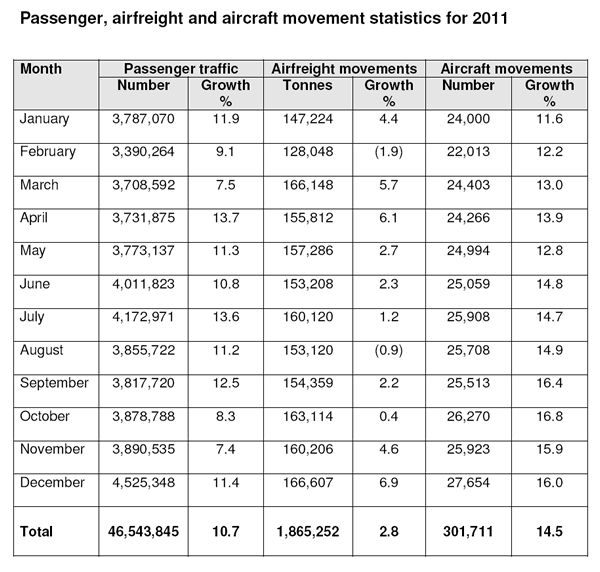
SINGAPORE. Singapore Changi Airport set new records in 2011 as it closed the year with a total of 46.5 million passenger movements and 302,000 aircraft movements, an increase of +10.7% and +14.5% respectively.
December 2011 was Changi Airport’s busiest month ever with 4.53 million passenger movements, a growth of +11.4% year-on-year. Changi’s daily record was also broken on 17 December 2011 with 165,000 passengers passing through during the 24 hours, surpassing the previous record of 148,000 passengers on 19 June 2011.
There were 27,700 aircraft movements last month, an increase of +16.0% compared to December 2010. As at 1 January 2012, Changi Airport handles more than 6,300 scheduled flights each week, an increase of +16.7% from a year ago. More than 100 airlines now connect Singapore to 210 cities in 60 countries globally.
 |
Growth underpinned by strong Asia Pacific traffic
Strong travel demand in Asia Pacific was a key growth driver for Changi Airport in 2011, according to Changi Airport Group (CAG).
Southeast Asia and Northeast Asia were the two best performing regions registering double-digit growth, while traffic to and from South Asia and Southwest Pacific also enjoyed good growth.
Long-haul traffic between Singapore and Europe continued to increase as CAG worked with airlines to drive demand and enhance connectivity. Significant developments in 2011 include the commencement of Finnair’s daily non-stop Helsinki-Singapore service and the introduction of Lufthansa’s A380 service on the Frankfurt-Singapore route. Changi Airport is now the world’s busiest multi-carrier A380 hub, CAG claimed.
 |
There was little change to the rankings of Changi Airport’s top 10 routes with Jakarta, Hong Kong, Kuala Lumpur, Bangkok and Manila occupying the top five positions. Despite a significant drop immediately after the March earthquake and tsunami, air travel to Japan recovered in the second half of the year and Tokyo has retained its position as one of Changi’s busiest routes. For the year, passenger traffic between Singapore and Japan grew by +2%, buoyed by industry efforts to revive travel demand.
Among sectors with at least half a million passengers, Taipei, Manila, New Delhi, Melbourne and Hong Kong registered the strongest percentage growth, reflecting the addition of capacity as well as an increase in demand to and from these markets.
In 2011, seven new carriers joined Changi’s family of airlines. Changi Airport welcomed Air Macau and Hong Kong Airlines while Finnair became the latest European airline to launch passenger flights to Singapore. Taiwanese carrier TransAsia Airways, India’s largest low-cost carrier (LCC) IndiGo and Lao
Airlines also began operations to Singapore.
Eleven new city links were added in 2011 at Changi Airport. These included Changsha, Nanning, Ningbo and Zhenghou, bringing Changi’s connectivity to China to 25 cities and cementing Singapore’s position as the most connected point to China from Southeast Asia. Other highlights include Changi’s first connection to South America via Singapore Airlines’ thrice-weekly service to Sao Paolo (via Barcelona) and Lao Airlines’ services to Vientiane, completing Singapore’s connectivity to all nine ASEAN neighbours.
In 2011, LCCs carried +26.3% more passengers while passenger movements on full service airlines grew +6.2%, albeit from a larger base. In terms of flight movements, LCCs accounted for 28.6% (2010: 26.3%) of all flights at Changi. One in four passengers passing through Changi currently travels on an LCC, compared to around one in five in 2010.
 |
Changi Airport Group Chief Executive Officer Lee Seow Hiang said: “It was an eventful 2011 for Changi Airport. Despite continuing economic uncertainty and environmental factors, we continued to develop the air hub and delivered another set of strong operating results. This can be attributed to the resilient support of our airline partners and passengers from around the world, and the dedication of all who work at Changi.
“Besides focusing on Changi Airport’s connectivity to the world, we remain committed to refreshing our in-airport service offerings so that our customers continue to enjoy the first class “˜Changi Experience’ they have come to expect. To that end, passengers can look forward to a brand new-looking Terminal 1 when upgrading works are completed later this year.
“At the same time, we are mindful that continued growth will increase pressure on Changi Airport’s ground and air traffic capacity. We are keeping a close watch on this and are working closely with the authorities and airlines to manage the situation, including implementing a number of changes to our on-the-ground operations.
“The outlook for 2012 remains hazy with the aviation industry expected to face volatile conditions. Demand for travel may moderate as a result of more subdued consumer confidence. Nonetheless, CAG will continue to work with its stakeholders to face these challenges and capture opportunities to grow together.”
Advertisement | |