


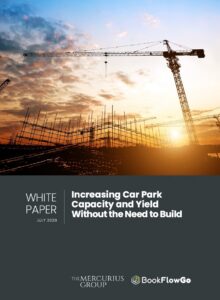
 AUSTRALIA. Non-aeronautical revenue and infrastructure advisory firm The Mercurius Group and parking technology provider BookFlowGo have released a white paper (cover pictured right) on the opportunity to enhance airport parking capacity in the Australian market.
The report examines how valet services and block parking can increase airport parking capacity while providing travellers with a broader range of parking options.
The paper also considers how these approaches could defer the large capital investment required to expand physical car parking infrastructure.
Car parking is one of the most valuable pieces of real estate at any Australian airport, the authors note. It generates an estimated A$800 million (US$556 million) a year in revenue and returns roughly seven times the yield of competing ground transport modes such as taxis, rideshare and public transport, according to the research.
That value is becoming harder to protect, the reports adds. Multi-storey car park developments in Australia now regularly cost A$55,000 (US$38,000) or more per bay to build, a rise of around +40% since before the pandemic, driven by labour shortages, material costs and lengthy construction programmes that can disrupt terminal operations for 18 months or longer.
As passenger numbers grow, pressure on airport parking infrastructure increases. The result: existing assets come under strain, with the risk of demand leaking to off-airport alternatives.
The paper also raises the question of obsolescence risk. With multi-storey car parks typically taking around 15 years to pay back, the authors question whether airports should be committing prime, terminal-adjacent land to permanent parking structures, given uncertainty over how connected and autonomous vehicles could reshape parking demand.
One under-used solution, they argue, is the use of valet services and block parking to increase the capacity of existing infrastructure. Widely adopted in other markets such as the UK, these remain largely niche products in Australia.
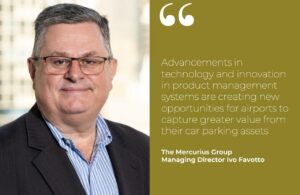
Mercurius Managing Director Ivo Favotto explained, “Valet and block parking solutions have traditionally been seen as labour-intensive, hard to manage products in the Australian airport sector. But advancements in technology and innovation in product management systems are creating new opportunities for airports to capture greater value from their car parking assets. The opportunity is to better segment the offer, turning block parking from a niche product to a more mainstream option.”
Favotto highlighted the ability of block parking to significantly increase the yield from airport parking assets, while freeing up land for other revenue-generating uses: “Ultimately, passengers want parking solutions that respond to their needs as those needs change. And with more transport options available, the best way to protect car parking revenue may lie not in pouring more concrete but in finding ways to offer consumers wider choice from the assets airports already have.”
BookFlowGo VP of Partnerships Neil Howes cited the example of the UK, where 90% of airports now offer valet parking as an option, compared with just 30% across Australia and New Zealand: “Properly supported by booking data and real-time operational technology, valet and block parking has the potential to unlock up to +40% more capacity from the same footprint, without the multi-year build times or the capital outlay of a new deck.”
Howes said the technology that has made valet operations commercially viable at scale in the UK is now available to Australian and New Zealand operators. “The reason high-density valet parking stayed a niche premium product for so long was the labour cost of running it well. Accurate booking and arrival data changes that. It lets operators schedule labour efficiently, sequence storage and retrieval, and run block parking with the same discipline as a much larger operation, without the cost blowout that used to come with it.”
With passenger numbers across Australia forecast to grow from 161 million to 250 million by 2040, and land within terminal precincts becoming an increasingly contested resource, the paper concludes that the case for evaluating valet and block parking has “never been more pressing”.
Increasing Car Park Capacity and Yield Without the Need to Build is authored by Diane Owens, Ivo Favotto and Matthew Quoi at The Mercurius Group, and Neil Howes at BookFlowGo.
To request a copy of the white paper, email: ifavotto@themercuriusgroup.com ✈