
 |
Eva Yu: A common vision and shared KPIs can help drive the industry forward |
ASIA PACIFIC. L’Oréal Luxe Travel Retail is determined to execute its responsibilities as a global leader in the travel retail beauty market, and play a full part in driving growth in the channel. But it can only do this with the engagement and assistance of airports and travel retailers, with a common vision of how to serve the consumer and with a more open attitude to data and information-sharing.
That’s the view of Eva Yu, the ambitious and engaging Managing Director of L’Oréal Luxe Travel Retail Asia Pacific, speaking to The Moodie Report in a wide-ranging interview about the P&C business in the division she leads.
The fast-growing travel retail division contributed almost 17% of net sales to L’Oréal’s luxury arm in 2012, with a significant contribution from Asia Pacific.
And as we reported from a fascinating tour of China and Hong Kong in the company of senior group management, the Chinese consumer is at the heart of its energies to grow the business. Against that background there is both opportunity and challenge for Eva Yu and her team in the region.
Acknowledging the increasingly vital role of the Chinese traveller in the business – the number one travelling nationality for beauty spend in Asia and worldwide – Ms Yu underscores the requirement for brands have to carefully tailor their offer, service and approach to this highly diverse nationality.
“Among the Chinese there are three areas of obsession that we need to react to,” she says. “One is the importance of skincare. We’re fortunate in that we have a wonderful portfolio that straddles categories and appeals to both men and women. As one of the earliest brands to enter China [over 20 years ago -Ed], Lancôme has reaped the benefits of its long-term investment. More recently Kiehl’s has performed exceptionally well.
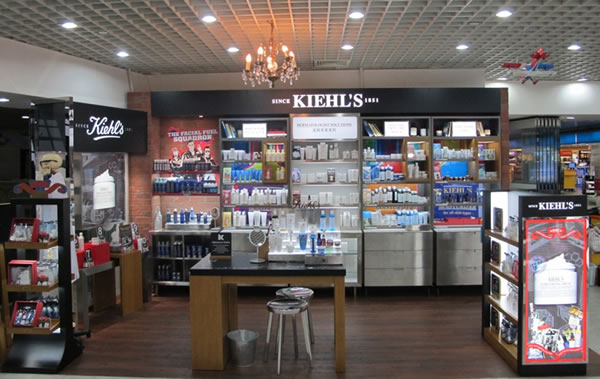 |
Kiehl’s: Now a powerhouse skincare brand among Chinese consumers at home and abroad (pictured here at Shanghai Airport Terminal 2) |
“Premiumness is another factor as this is what the Chinese traveller seeks, and how we communicate that is important. We invested much in dramatizing the roll-out of Giorgio Armani to the Chinese customer, and Helena Rubinstein provides other solutions in high quality, premium skincare.
“Gifting is the other prime area of focus. Some 55% of Chinese spend in beauty is in gifting. That means showcasing exclusive offers is vital. We’re assisted in this by our strong creative and design team that is dedicated to travel retail specific offers.”
But with such a huge audience of potential shoppers, the differences between Chinese customers are as important as their similarities.
 |
Asian adaptation: Shu Uemura on display at Taipei Airport |
“We have to be mindful that there are many needs among Chinese travellers,” she says. “Those from Tier 1 cities do not shop in the same way as those from Tier 2 or 3 cities. That makes a tailor-made approach from brands even more important. For some travellers outside the Tier 1 cities it’s often the first time they are travelling abroad so the way you introduce the brand and speak to those passengers is key.
“There are also significant differences between how group tour travellers shop, and how individual travellers shop among the Chinese. Tour groups often have limited time – maybe 45 minutes at a downtown duty free store – while individual travellers naturally can stay longer – so you need to ensure your offer and service are adapted to this.”
 |
Lancôme’s La Vie est Belle travel retail execution with DFS in Auckland |
L’Oréal, notes Ms Yu, is well placed to understand the Chinese and other emerging nationalities in Asia Pacific.
“We have a number of advantages that are also going to be drivers of our business. These include a complete and balanced portfolio of balanced, ranging from premium to accessible to fashion designer brands, and more recently the addition of Clarisonic and Urban Decay has really intensified our coverage. That means we can be more relevant to many types of consumers in Asia Pacific.
“Our use of technology means we can adapt to the needs of every consumer type also, whether it’s through our product formula, our textures or our packaging, to suit the Asian complexion. Then, as you know, we started in Asia very early so we have enormous knowledge of the market.
“Beyond this, one of the most important opportunities and drivers is tapping into the needs of “˜the global shopper’ from countries including China, but also Brazil, India and Russia. We aim to adapt to them through our retail excellence, our training and merchandising, and do it as much as we can on a door by door approach.”
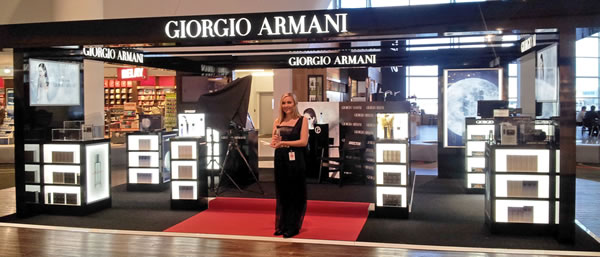 |
Giorgio Armani: Taking the high-end approach |
That drilled-down adaptation to the consumer is highly desirable but it’s not so easy to achieve, especially in travel retail.
“Targeting the traveller door by door is not so easy when you are missing information, which we frequently are,” says Ms Yu. “That is an industry issue. We need better information on nationality mix but also common KPIs, like average basket size, footfall and penetration by category. This would help us do an even better job and it’s an industry opportunity.”
What needs to change for that to happen?
She notes: “There is the opportunity to make travel retail a preferred environment but that requires a common vision. It’s also important that we as stakeholders talk more about the customer instead of the focus that we have overwhelmingly today on “insider topics” such as margin. To grow our partnerships in this business we need to be more customer-centric, developing those KPIs that we share and can work towards.
“We need more input from the airports’ side. We all have our part to play but airports have the power to help turn travellers into shoppers by making the airport a destination in itself. The retailer too has a role in creating the alluring environment that will entice passengers in, and brands have their role in assisting them with great products, merchandising and service.”
 |
Lancôme has made a big investment in targeting the Chinese in their home market and overseas (Hong Kong International Airport pictured) |
A better understanding of the consumer is a core issue, and one that Ms Yu emphasises a number of times as we speak.
“It’s very important for our industry to improve on its CRM capabilities. Today we don’t recognise our customers when they come to our counters. We don’t have data on them. Compare that to downtown, where the retailer knows your history, what you like, what you’re allergic to, and so on. Through CRM the retailer can do targeted marketing and send them information relevant to their profile.
“In travel retail, every customer is like a new customer, every time they shop. You have to ask what they like, what their skincare rituals are and start with a range of possible products for them. It’s not sophisticated enough. Imagine if you had better data and could have a relationship with these customers before they even travel.”
 |
Wow factor: The Lancôme podium at Beijing Airport |
Improving the industry’s consumer insights, allied to the will to work together through common objectives, can help deliver on the big area of opportunity: low penetration levels among travellers.
“We need to go beyond our reliance on passenger traffic to grow the business,” says Ms Yu. “Raising penetration – only 13% in P&C in travel retail – is the opportunity. But unless we take action we will continue to suffer from low footfall and penetration.”
Addressing the quality of the traveller experience has to be among the industry’s goals, she adds, especially given the competition, notably from the High Street. L’Oréal Luxe, she says, is investing in making a difference here.
“We know that consumers travel the world and see what is available and how it’s presented at the most premium department stores and speciality stores – so we have to make the travel experience memorable to compete.
“A recent example from our business was how we created a stunning new Lancôme podium at Beijing Airport, linked to the Absolue franchise. Rather than simply selling product it’s all about the experience – in terms of consultation, hand massage and other treatments, all delivered in a premium way, in a space close to the beauty store. That experience is something quite unique. When you consider the level of traffic at Beijing it’s a superb showcase.
“This is how we as a brand owner can contribute to the Trinity, but we also need the access I mentioned to better quality information, and common KPIs with the retailers. For example, I would like to know how much did I help to increase footfall in the P&C store through having this podium in Beijing; how much did I bring to the skincare category; did I recruit customers who never used Lancôme before, and did I increase the average basket because of this wonderful service that people enjoyed? These are areas we would like to know more about so we can help the total business grow.”
Stores and campaigns such as the Beijing Airport podium also address what some retailers perceive as a lack of innovation among the big beauty houses. It’s a claim that Ms Yu defends L’Oréal Luxe against.
“If you talk about value added innovation, then we do this and we do it well,” she says. “We have superb technology that enables us to design and create new products and channel exclusives tailored to the consumer. We have the knowledge of the Asian traveller through many years of experience and we have the retail expertise to serve the traveller.
“If you look at the level of retail-tainment that the major categories deliver in travel retail, you could make an argument that liquor has shown the way recently with some wonderful executions. But P&C brands also do this well.
“In my time in travel retail I’ve discovered how difficult it can be to do new things in the airport environment. That’s why we need the airports’ input so badly.”
 |
Biotherm: A premium brand for the growing men’s market |
As a market leader in the channel, with a presence across the P&C offer from skincare to fragrances, L’Oréal Luxe has a vital role to play in driving the beauty business in Asian travel retail.
As our interview draws to a close, I ask Ms Yu what the company can do to underline its leadership credentials and reinforce its commitment to the channel?
“First, on the category side, it’s our mission to offer the best in beauty. It’s our company strategy to lead a drive towards “˜universalisation’ but one adapted to each customer’s skin rituals. Our adaptation to Asia through tailored products and services is key to this.
“In our position we also have an industry responsibility to contribute to the Trinity, and our commitment to promoting travel retail to people outside the industry. It’s slowly becoming recognised as a new and exciting channel of shopping, but it’s still not promoted in the way it could be.
“It’s also an incredibly important market for us as a house of brands to test new products, and to invest in. Our investment is another way in which we as a market leader commit to the channel.
“Our strategy is to target the “˜global shopper’ wherever they travel, in the domestic market but also in the travel channel. Our responsibility here is to tailor our offer to this global shopper through the best service and adapted products and packaging so we can drive footfall.
“These are our commitments, but we need support from airports and retailers to ensure we get a return on our investment. And that means building an industry that is more customer-centric than ever, that commits to sharing data and information on our customers.
“If that happens, then P&C can really fulfil its role as one of the industry’s great footfall drivers.”