

INTERNATIONAL. The second gathering of the Travel Retail Data Innovation Group (TRDIG) in Hamburg last Tuesday marked a significant step forward in the organisation’s objectives to accelerate the global exchange of master data in the travel retail channel.
National consumer goods markets have been using data pooling solutions to exchange standardised product information for around 15 years, so the duty free industry is playing catch up.

At the TRDIG Strategy Meeting 2019 the 90 suppliers in attendance easily outstripped the 35 present at the first meeting a year ago – a very positive sign. They were hosted by five top travel retailers – DFS Group, Dufry, Heinemann, Kappé International and Lagardère Travel Retail. In total there were 190 attendees, up from around 100 in 2018.
Perhaps the most important aspect of the meeting was the extent to which key retailers have already developed their product data pools in tandem with suppliers, 30 more of which were onboarded recently, according to TRDIG. In 2019, multiple live test projects were launched after completing proof-of-concept phases.

The whole initiative was started by Gebr Heinemann in 2017, and has snowballed to become an influential community of suppliers, retailers and technology service providers such as 1WorldSync and Alkemics. They have jointly established a new and streamlined system of product information transfer in travel retail.
The ultimate aim is to create a product data hub in the cloud – using established GS1 standards – to enable automated data exchange. This is regarded as a Holy Grail in terms of driving efficiency and saving time by reducing manual data inputs. Importantly it would also end the need for numerous excel product templates being constantly emailed between suppliers and retailers.

At the meeting, Gebr Heinemann Director Fulfillment Inken Callsen told The Moodie Davitt Report: “The benefit for the industry is that you have one entry source [a one-to-many system] and the quality of the data is increased which saves times [as queries inevitably decrease].
“In domestic markets this already exists but mainly for fast-moving consumer goods (FMCGs) – it is well established in the liquor, tobacco and confectionery segments. It is new for perfumes and cosmetics, while fashion is in a fledgling phase. So it is different from category to category, and it is also often country based. In travel retail we are combining a lot of categories and, as a global customer, we we want global information.”
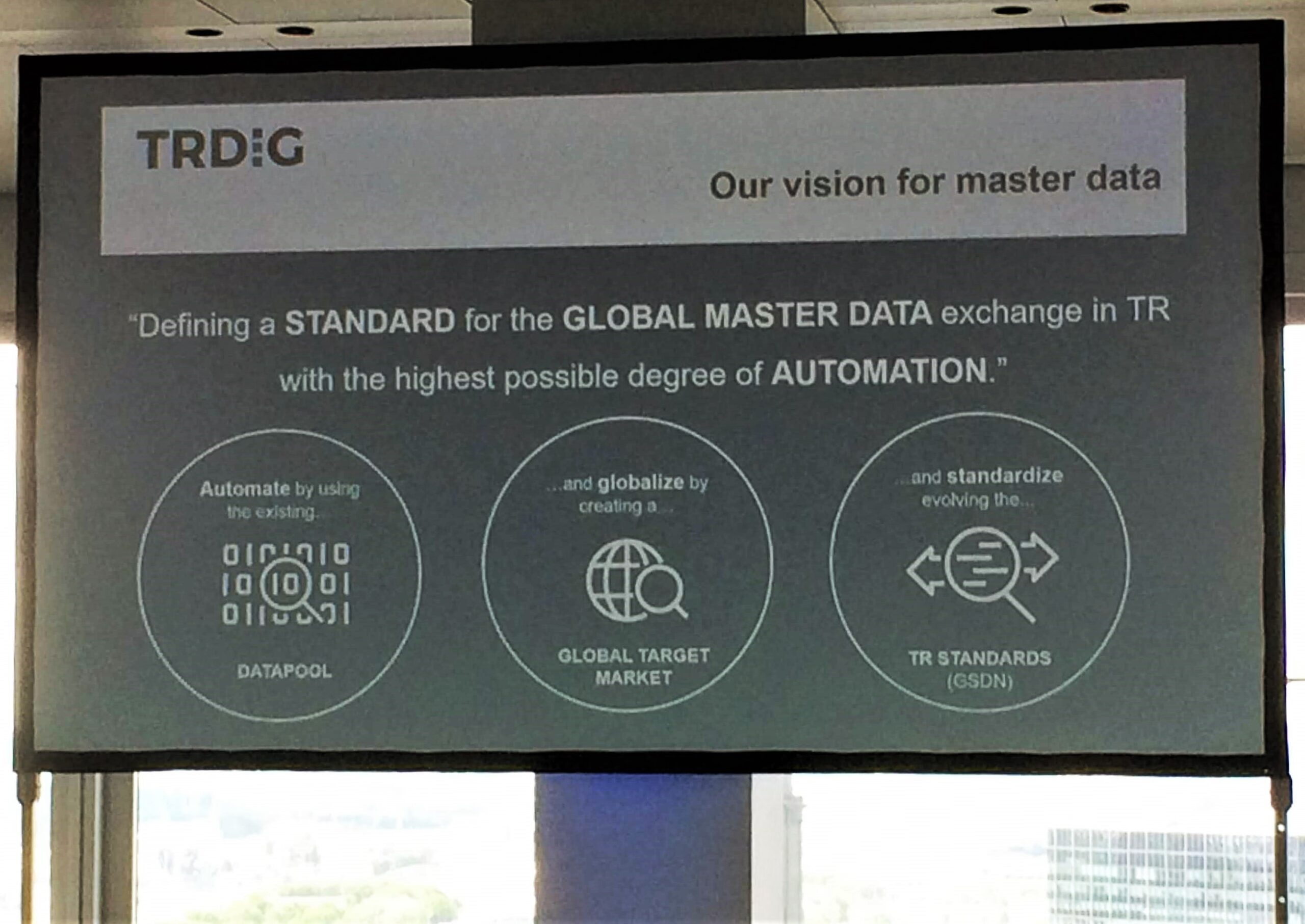
Members of the GS1 Global Office were on hand at the meeting. They said that, as part of their new Global Data Model – designed to handle the complexity of data exchange at the worldwide rather than national level – they would establish a specific travel retail component starting with alcoholic beverages.
The six steps to cloud data heaven TRDIG believes that that the six-step process below will allow suppliers to initiate the global exchange of product master data within a year, but in some cases the set-up could be as short as seven months. 1. Commit to TRIDG |
The not-for-profit organisation stated: “On the supplier side, by creating product information (this way) you will be able to save about 50% of the costs involved due to the reduction in customising data for individual retailers’ needs.”
A more secure system
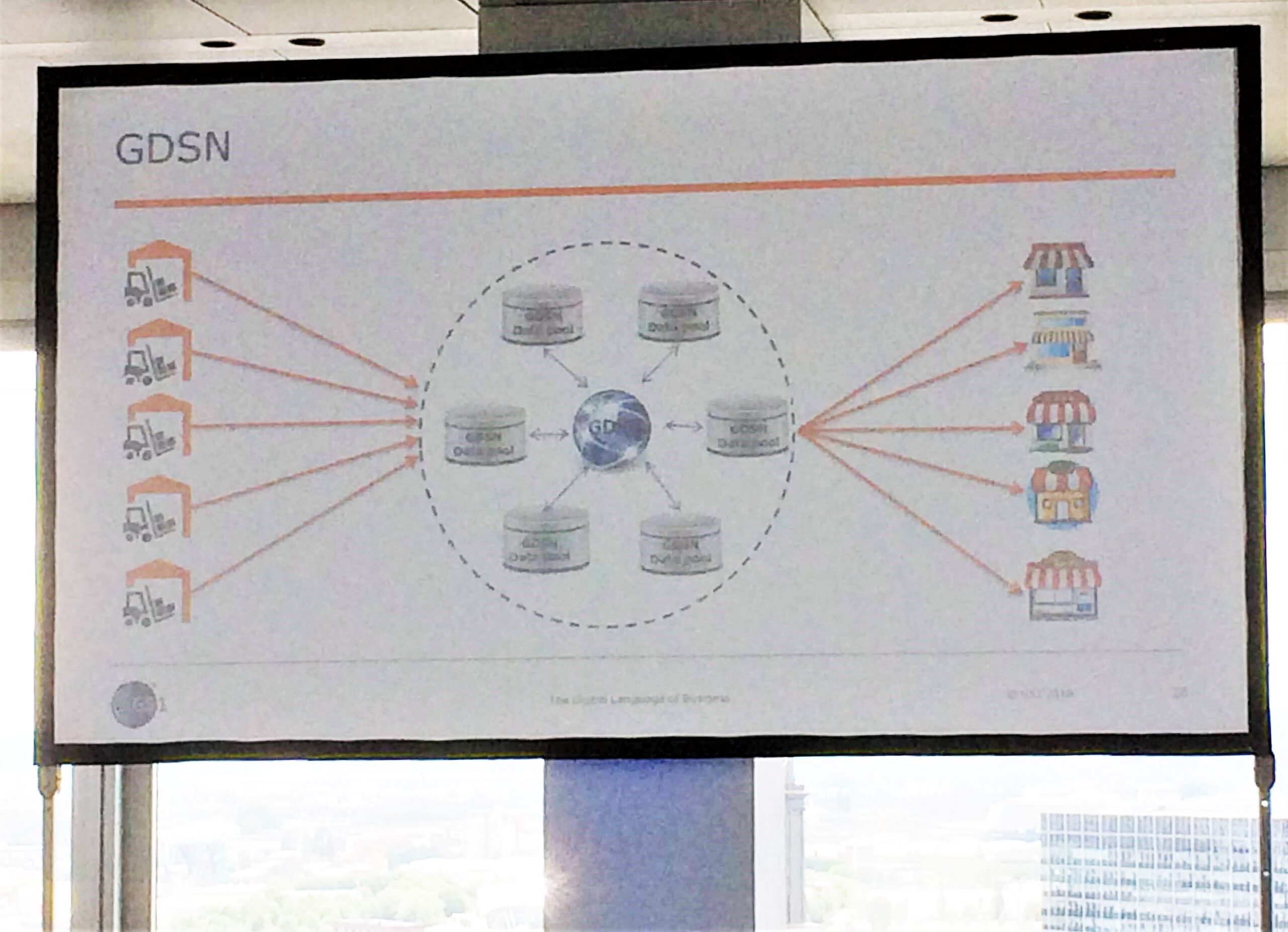
Underpinning GS1 standards is the Global Data Synchronization Network (GDSN) – an internet-based set of master data pools that form an interconnected worldwide network. GDSN ensures that master data exchanged between trading partners complies with GS1 standards.
In simple terms, suppliers can securely send their complete product data – in a strict, standardised format – to these pools, which can then be seen by travel retailers only if they have been granted access to these data.
Such a system is much more secure than email. Also, once data have been input they can be adapted and adjusted as the product lines increase or evolve, and travel retailers are immediately alerted. This eliminates needless email traffic.
Heinemann and Lagardère are well advanced
Heinemann, having initially begun test work with Imperial Tobacco, went live with the tobacco company in 2018. By May this year, the retailer had added Mars, Bacardi, Ferrero and JTI International to its data pool roster and from June, beauty players Dior, Clarins, La Prairie and L’Occitane will come aboard.

By September further brands will join, including Coty, Lindt, Moët Hennessy and Puig, plus a new category – accessories – notably sunglasses player Luxottica. By the end of the year some of the big portfolio beauty giants will be added: The Estée Lauder Companies (with around 4,000 skus), Shiseido and L’Oréal.
Also, in October, GS1 Germany is creating a fashion pilot (see below for details). Heinemann Project Manager Fulfillment Laura Moser said: “We would love to have this category in the data pool as well. Fashion is the category that is least developed so we need to press the accelerator here.”
France’s Lagardère Travel Retail has had its foot on the data pedal for a while and was clear about its approach. The company’s Supply Chain Director Sophie Boasson told the audience: “We are all in the same boat. If you go towards a data pooling solution, we will all be winners.”
She articulated why: “We need to be better with time-to-market. Our consumers want the latest novelties and all product information available to them – now. They don’t want to wait. If they don’t find it in our network, they’ll find it somewhere else.”

Lagardère Travel Retail kicked off its data pooling project in January and is currently in a testing proof-of-concept phase with about ten brands, after which will follow an implementation phase in Q3, according to Data Quality Manager – Duty Free Global Karim Belaidi.
“The target is to implement two elements: internal workflow validation to ensure the product information is correct, and data quality control,” he said. The company plans to go fully live in Q4 this year with the onboarding of suppliers and brands continuing into 2020.
Other travel retailers also move forward
DFS Group did not give a presentation at the meeting, but Executive Vice President Merchandising Ariel Gentzbourger said, as part of a statement read out by Heinemann Chief Commercial Officer Kay Spanger: “DFS is committed to the TRDIG vision and we are confident that the establishment of a global travel retail data model will prove fruitful to all.”
At Kappé International, the company started its digital data programme last year and is integrating systems and establishing a product information platform. “We get a lot of scattered data and it takes a lot of effort to get the right data to the right people at the right time.” said Program Manager José Rebelo. “We hope to have centralised our data by the end of this year.”
Dufry Global Head of Master Data Alessia Poveromo also emphasised quality of data as an issue, as well as speed to market. “We suffer a lot with the data quality we receive,” she said, noting that manipulating this data was very inefficient.

The company has simplified its data model and developed the Dufry Vendor Portal which has been tested with four suppliers and which will be rolled out to other vendors in Q4. Poveromo added: “We are committed to the master data model and making this our future solution.”
On the supply side came presentations from beauty player Nuxe on its use of a data pool with Lagardère Travel Retail; Nestlé which, as a leading FMCG player, is already well advanced in the field of product data across its more than 2,000 brands; and newcomer to the game, Puig, which described TRIG as “an essential strategic enabler” for its travel retail future.
The question of cost price
Some caution about what data should be included was clarified in stark terms by two retailers. Poveromo said that for the system to be truly efficient, Dufry needed 100% of the master data. “What’s the point of receiving just 80%, if we have to fill in excel templates for the remaining 20%? This includes cost prices and testers,” insisted Poveromo. “If we don’t have the cost price we are not going to purchase.”
Callsen said that full data sets would require the integration of pricing. Cost prices were also deemed essential to data inputs by Spanger, who said: “We should not exclude cost prices – it is normal in domestic markets.”
Speaking to The Moodie Davitt Report, he elaborated: “What is more secure – sending an email or using a digital system? Always via a system. We have received emailed offers meant for Dufry and others, and they have probably received ones meant for us. So the issue (regarding cost price communication) is security, not about deal negotiation. At the end of the day, cost price is just another datum although the mindset of travel retail has been one of ‘You shouldn’t see my price’ but in domestic it’s very established.”
Smaller suppliers will not be left out
A number of smaller suppliers at the event told The Moodie Davitt Report they were concerned about how data pooling might work for them given their lack of IT and system resources. We put this to Spanger who said: “We are discussing what process we can use with smaller suppliers so that they can also participate. On the domestic market, big retailers like Metro and Boots have very small suppliers and they all manage to send their data.

Callsen added: “The difference is that big suppliers will use a machine-to-machine link whereas small suppliers can upload manually to the cloud.” The Moodie Davitt Report understands that Heinemann will confirm and communicate to smaller suppliers a process for data delivery to the cloud by the end of the summer. They will then have about six months to implement it.
For bigger suppliers, however, Spanger was unequivocal and told them: “After a certain date [likely to be next year-Ed] we will let you know – probably at our Strategy Day – how we will invoice you back if master data is not automated.”
Well defined next steps
With most product categories on side, the TRDIG Strategy Meeting 2019 laid the foundations for onboarding the fashion and ancillary categories, considered an essential next step. “The category with the highest number of skus is the least advanced (with the data pool concept). However, fashion brands are now involved in the project and we are using a community approach to make this happen,” said Callsen.

“There is, from the German group, a fashion data set, that we can use already to implement a pilot,” added Moser. At the meeting, a special round table session – one of several – was held for the fashion segment. This resulted in both Hugo Boss and Ralph Lauren agreeing to set out a roadmap for developing priority data attributes, starting with the German market.
The overall mood at the meeting was highly positive, even though there was inevitable hesitation in some quarters. As more live pooling takes place and more suppliers and product groups are added, cloud-based product data transfer looks set to become well established by next year.