
 |
INTERNATIONAL. The new UNWTO World Tourism Barometer Provisional data on international tourist arrivals, just published, gives an upbeat insight into global tourism performance for the first eight months of 2007. And it points to a continuation of the sustained growth rate experienced over the past years.
From January to August, destinations worldwide received an estimated 610 million international tourist arrivals, an increase of +5.6% year-on-year.
The Northern Hemisphere high season months of July and August were “remarkably strong” said UNWTO (World Tourism Organization), especially given the fact that capacity was already tight in this period.
For the first time ever, both July and August topped over 100 million arrivals each, a rise of over +5% in both months.
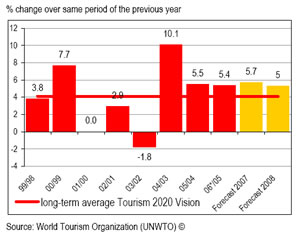 |
A tale of protracted growth: International tourist arrivals 1998-2008 (forecast) underline the strength of recent years |
The full year forecast suggests that this trend is likely to continue through the remainder of 2007, with year-end growth estimated at +5.7%. This suggests that 2007 will close with over 880 million arrivals and might even approach 900 million, the Barometer said.
For 2008, only a very slight softening is expected to around +5% – therefore sustaining an above-average growth rate.
With an estimated increase in the range of 5-6%, 2007 is set to be the fourth year of growth above the long-term average of +4.1% a year.
Growth has been very much driven by emerging destinations in Asia and the Pacific, Africa and the Middle East, while the more mature regions of Europe and the Americas are showing a more moderate pace, though still well above their respective long-term averages.
ECONOMIC STRENGTH DRIVES TOURISM -DEVELOPING ECONOMIES KEY TO GROWTH
One of the main contributors to 2007’s continued strength in international tourism has been the strong global economy, with world GDP in 2007 heading for a +5.2% increase – the fourth year in a row with GDP
growth at around +5%. The impact of the recent turbulence in financial markets is not reflected in tourism performance, UNWTO noted.
“The actual growth trend in international tourism is supported by the spurt in economic growth of the recent years, worldwide, but in particular in the world’s emerging market and developing countries. Economic growth has reached a historic record in this group of countries, both in terms of the level of growth achieved and the length of time this has been sustained.”
In its latest World Economic Outlook the International Monetary Fund broadly maintained its previous positive tone, UNWTO noted, projecting economic growth to continue next year at only a slightly lower pace.
ASIA PACIFIC’S STAR STILL IN ASCENDENCY
Although regional trends may vary as new data becomes available, Asia and the Pacific is currently the star performer, recording an increase through August of +10%, ahead of the Middle East and Africa,(+7% and +8%). Growth for both Europe and the Americas currently stands at +4% – one percentage point down on 2006’s level in the case of Europe, but twice the rate of growth of last year for the Americas.
March has been the best month globally for travel with arrivals up by +9%, boosted by the fact that Easter fell in that month rather than in April as in 2006. Strength was maintained during the Northern Hemisphere high season months of July and August (both ahead +7%). Results were boosted by poor weather in some North and West European markets which encouraged last-minute demand for foreign travel.
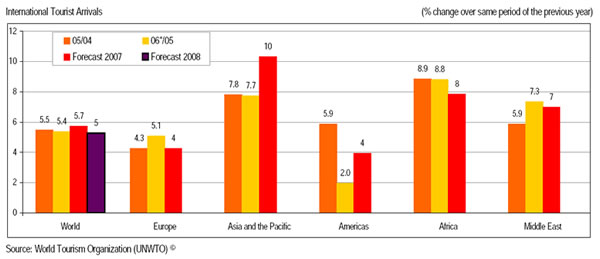 |
International tourist arrivals by region 2004-2008 (forecast) – note the Asia Pacific performance this year |
OPTIMISM TEMPERED WITH CAUTION”¦ AND OIL CONCERNS
The fact that 2007 is the fourth year of healthy growth worldwide confirms that tourists have generally been undeterred by external threats, whether related to terrorist activities, health and security scares, increased taxation of air transport and tourism, exchange rate fluctuations or even economic uncertainties, UNTWO said. “But this state of affairs may not continue indefinitely,” it cautioned.
Economic vitality and increased competition have triggered demand for air transport despite the high costs of fuel, it said. The price of oil is now poised to tip the US$100 a barrel mark.
In a key comment, UNWTO said: “Overall the price rise seems to have been absorbed so far. Increased operating efficiencies, including staff cost economies, have compensated significantly for the rising share of fuel in airlines’ total costs.
“However, it should be noted that the representatives of the transport sector in the UNWTO Panel of Experts are among the least positive both in “˜evaluation’ and “˜prospects’. The growth of low-cost air transport around the world – which has made air travel accessible to an increasing share of the world’s population in advanced economies, but also in emerging market and developing countries – has also boosted demand for short-haul flights.”
2008 – Some Softening But Outlook Positive
International tourism demand will soften in 2008 but will still be above the long-term trend, UNWTO said. The increase in international tourist arrivals is projected to be around half a percentage point lower than in 2007, thus around +5%, but still above UNWTO’s long-term annual forecast growth of +4.1% through 2020.
Here is a quick snapshot of prospects by region:
Asia Pacific will continue to lead the growth in international tourism in 2008. China, already one of the stars of 2007, is likely to benefit from the 2008 Beijing Summer Olympics. The economic strength of the region as well as further low-cost carrier development will continue to drive intra-regional growth.
Africa is also forecast to maintain growth at a fairly high level. South Africa is already benefiting from its scheduled hosting of the 2010 FIFA Football World Cup.
But growth is expected to slow in the Americas. A further depreciation of the US Dollar is expected to influence the outbound market [though conversely stimulate certain inbound markets – Ed]. The further implementation of the Western Hemisphere Travel Initiative will be a major development to monitor – in particular regarding its impact on US outbound travel to Canada, Mexico and the Caribbean.
Latin American destinations are expected to continue to prosper, both from intra-regional and inter-regional source markets, boosted by improving economic results in the region.
UNWTO says, perhaps surprisingly, that the Middle East will slow in growth, though the message is still upbeat. Upcoming developments in destinations such as Abu Dhabi or the completion of the Palm Jumeirah in Dubai will continue to mark tourism in the region. Middle East intra-regional traffic is also expected to continue benefiting from increased disposable income as a result of rising oil prices.
Europe’s growth will ease marginally. Factors impacting on regional performance include the expansion of the Schengen zone from the end of December 2007. This will include nine of the countries which joined the European Union in 2004 (Estonia, Latvia, Lithuania, Poland, Slovakia, Hungary, the Czech Republic, Slovenia and Malta) while Switzerland is set to enter in November 2008.
Furthermore Malta and Cyprus will adopt the Euro in January 2008, expanding the eurozone of 15 countries. Switzerland and Austria are counting on next year’s European Football Championship to boost demand for the two destinations.
For more details see www.unwto.org
MORE STORIES ON THE WORLD TOURISM ORGANIZATION
WTO bullish on global tourism growth as first four months show +6% surge in travel – 29/06/07
World Tourism Organization celebrates 2006 as a record year for global tourism – 29/01/07