

| Yilin Consulting & Yilin Watch Yilin Consulting, owned by Yilin Wang (pictured) is an acclaimed boutique consultancy based in Paris, specialising in helping brands and retailers engage the new generation of Chinese outbound travellers.
Its focus lies in converting independent, experience-driven travellers through targeted omnichannel engagement and frontline cultural training. Today, as part of our unrivalled coverage of the Chinese travel retail market at home and abroad, The Moodie Davitt Report proudly brings you the ninth edition of our exclusive Yilin Watch column in partnership with Yilin Consulting. |

Yilin Watch is published in exclusive association with The Moodie Davitt Report
Prologue: Yilin Watch is entering a new chapter. Each month, I will write from inside the travel retail industry about the Chinese travellers we are all trying to reach (one of them, frequently, being myself).
These are one person’s experiences. Like glimpsing a leopard through a bamboo tube, I can only ever see one spot at a time. And, as we say in China, I offer a modest brick in the hope of drawing out jade, my small view put forward so that sharper ones across the industry might follow.
My sincere wish is that we come to see (and treat) the Chinese traveller with a little more warmth, and a little more attention.
Recently, I flew with my family from Paris to Beijing. Wow, it was such a long journey.
It started with a very stressful last-minute packing. Our flight was at 20:20. We were in the taxi around 16:15 after a 15-minute delay from the driver.
Then an hour on the road, with an accident on the A1 that cost us another 20 minutes. We thought four hours before a long-haul departure was enough. It was not.
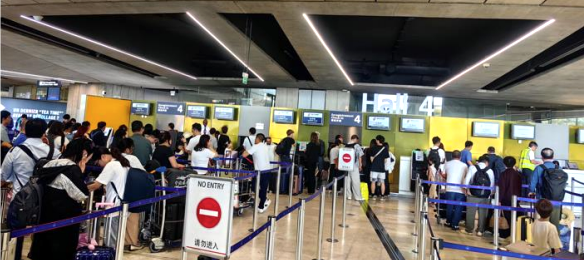
By 17:15, we finally placed our luggage on the trolley. The queue before check-in seemed infinite. We simply could not see the end of it in the hall.
So we pushed our cart against the human tide, past four or five advertising panels, and near the boarding gate we finally found the end. Every few metres, we checked with the people beside us. “Beijing?”
Yes.
This was it.
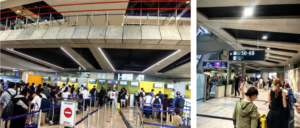
The queue barely moved, even though most counters were open. During the hour we stood there, I tried to convince my husband to learn a few Chinese words from the trilingual boarding screen, to make better use of the time. He was not in the mood.
When we finally reached the counter, a friendly gentleman explained that the foreigner arrival card, once on paper, was now digital, filled in by scanning a QR code, ideally on our own connection while still in France.
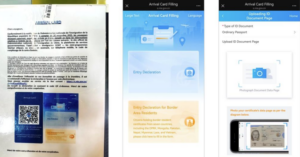
By 18:20, border control. Fluid and fast, we passed through as a family. Bingo!
Then security, and this one was a mixed experience. The good side: no need to take our electronics out of the bags. The downside: two of our three cabin bags were pulled for a random check. More waiting.
We reached the airside departures area around 19:30. To make the most of our impending two-hour transit in Beijing, I filled in the arrival forms on my phone while my husband and daughter went to the Relay store. One Evian and a crime novel for my husband. One Mortelle Adèle (comic book) for my daughter. That was all we bought.
By the time I finished filling in the two forms, the queue had already formed at our gate. We joined it. Our flight took off at 20:20 sharp. Finally. Summer holidays, all the stress behind us.
And in all of this, I missed a step. As a travel retail professional, I had not made my usual counter visit. As a family traveller, part of the Chinese diaspora heading home for the summer, I usually love to wander the duty-free stores. Visit. Buy something random. Just surfing on the pleasure of heading back to my roots.
This time, it was not possible.
We didn’t even stop for a coffee, our little routine to release the nerves after all these steps.
We had simply walked through the duty-free store. That’s it. Yes, we made some purchases at the airport. But we were too time-pressed to go further, too drained even to take a quick photo as we passed. A typical stressful tipping point before the long-awaited family reunion.
The passenger does not experience owners. She experiences one continuous journey. The industry manages it in silos. She lives it in one breath.
In nearly two decades of travelling between Europe and Asia, this was the first time I didn’t spend any time in the duty-free store. A friend told me the same, and she had left even more time than we did. She barely made the gate.
As someone who advises brands on their travel retail strategies for Chinese travellers, this alarmed me. In travel retail, we traditionally count on the impulse purchase, on dwell time in the airport, on the eye-catching HPP.
But what if a Chinese passenger is simply not at ease to shop, because the journey has already taken everything out of them? This problem is not restricted to Chinese travellers.
A passenger simply passing through the commercial area. A passenger who technically has 15 minutes. A passenger who has genuine available time to shop. These are three different people. The industry counts the first two. The sale depends on the third.
I was travelling east, returning to China rather than arriving in Europe. The operational conditions are not identical. But the question travels in both directions. How much of the airport time we count is genuinely reachable in retail terms, and how much of it is already wasted on stress?
Seeing the Chinese customer does not require Mandarin. It begins with a greeting, one relevant question, and the ability to read her intention quickly, even when she is looking down at her phone.
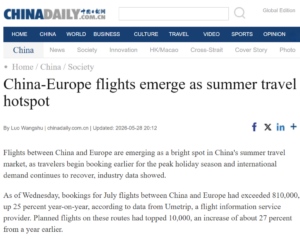
The question matters more this summer than most. As of 27 May 2026, bookings for July flights between China and Europe had already passed 810,000, up +25% year on year (Source: 1Umetrip data reported by China Daily, 28 May 2026).
The figure covers travel in both directions, not only Chinese arrivals into Europe. More travellers. More airports already tight on time.
The question I keep being asked
For two and a half months, one question has followed me. What is the cultural faux-pas to avoid? The one thing we must never do with Chinese travellers?
Frontline teams asked me twice in my monthly masterclass to airports and downtown designer outlets across May
and June. Then again in early July, on an industry panel dedicated to the Asian traveller.
My answers kept getting shorter.
My first response was to not confuse Chinese travellers with other nationalities. True, but it began with labels rather than people. The second time, my answer was shorter. Do not ignore them. The third time, even shorter. See them.
Why does this question keep coming back? I think I understand now. When engaging Chinese travellers feels hard, whether because the knowledge, the budget, or the direction isn’t there yet, the safest instinct is to make sure we at least get nothing wrong.
But standing still is itself a choice. And with one of travel retail’s most valuable customer groups, it is a costly one, commercially and humanly. This shifts slowly, mindset before policy. Which is why it is worth sitting with, gently.
And here the two halves of my summer meet. Two questions that stayed with me. First, can the traveller still see the store? Then, when she walks in, does the store see her? Same customer. Two ways to lose her.
Seeing her does not require Mandarin. It begins with a greeting, one relevant question, and the ability to read her intention quickly, even when she is looking down at her phone.
Acknowledge her presence. Sense the stress behind it. Notice what she is looking for, and help her find it.
Before launching any campaign, one distinction is worth mentioning. Are we measuring how long a passenger is spend in the shopping zone, or how much of that time she is actually able to spend money?
Which departing passengers consistently arrive in the commercial area with nothing left to devote to it, no attention, no ease, no appetite? And when a passenger finally does walk in, is the team ready to lower her stress rather than add to it?
None of these issues belongs to one player alone. The road accident, the drive to the airport, check-in, border, security, boarding – each belongs to a different party.
None of us sees the whole picture. But the passenger does not experience owners. She experiences one continuous journey. The industry manages it in silos. She lives it in one breath.
We continue asking whether returning Chinese travellers will keep spending in airport duty ree. Perhaps we can also ask another question: are they in the right mood to shop? An exhausted traveller does not shop. A traveller at ease does.
Before we ask how to convert passengers to shoppers, perhaps we should ask whether the journey leaves them anything to arrive with. And when they walk in, will we see them? ✈
{At Yilin Consulting, we design practical frontline programmes for travel retail teams, equipping Brand Ambassadors with the cultural confidence and conversation tools to convert Chinese visitors from the very first interaction.}
Contact: yilinwang@yilinconsulting.com
Yilin Wang | Founder & CEO, Yilin Consulting, Paris
Previously on Yilin Watch: The Xiaohongshu Report
Edition 5: Yilin Watch: The Xiaohongshu Report – Targeting the year-end Chinese traveller
Edition 2: Yilin Watch: The Xiaohongshu Report – Focus on Qatar Airways, Cathay Pacific and All Nippon Airways
Edition 1: Announcing a key new editorial column – Yilin Watch: The Xiaohongshu Report