


Yilin Watch: The Xiaohongshu Report is published in exclusive association with The Moodie Davitt Report
Introduction: Yilin Consulting is an acclaimed boutique consultancy based in Paris, specialising in helping travel retail brands and retailers engage the new generation of Chinese outbound travellers.
Its focus lies in converting independent, experience-driven travellers through targeted omnichannel engagement and frontline cultural training.
Today, as part of our unrivalled coverage of the Chinese travel retail market at home and abroad, The Moodie Davitt Report proudly brings you the eighth edition of our exclusive column in partnership with Yilin Consulting Founder Yilin Wang – Yilin Watch: The Xiaohongshu Report.
The Last Stop Must Earn Its Place

Shopping did not disappear from the Chinese outbound journey. It just stopped leading it.
The question for travel retail this summer is whether it deserves a place on that route.
Prologue: The Plans Are Already Made
For anyone planning a summer trip, the first question is rarely: What should I buy at the airport duty-free store?
This is especially true for today’s Chinese FIT travellers.
By the time this edition reaches you, Chinese families are already deep into their summer planning. The Gaokao [China’s hugely competitive national college entrance exam] is just days away. School holidays start in early July.
The window between now and departure is short, and the questions and decisions are forming right now:
- Where is safe to go?
- How to save smartly on flights and accommodation?
- Which routes make sense?
- Which local experiences are worth the time?
- Which restaurants can satisfy a Chinese stomach while still offering a real taste of local cuisine?
- Which shopping stops are genuinely worth a detour?
Shopping has not disappeared from this picture. Far from it. Shopping still ranks third among spending priorities for Chinese outbound travellers during the May Golden Week, with 39% planning to increase their spending on shopping, particularly among travellers aged 18 to 24.
But 56% plan to increase spending on activities and experiences, and 49% on dining [Source: Dragon Trail International, The Value of Travel in a Changing World: Chinese Traveller Sentiment Report, April 2026].
Shopping remains powerful. It has simply found its place in a longer list of intentions, and it is no longer at the top.
This is the shift that travel retail must read now. And the stakes are real: Chinese outbound travel to Europe is forecast to grow between 10% and 18% this summer, driven by expanded Chinese carrier capacity and lower year-on-year ticket prices [Source: China i2i Group, Air Ticket Pricing Intelligence: China Outbound Summer 2026, April 2026].
Chinese travellers are coming. The question is whether travel retail is ready to meet them where their priorities actually are. This edition examines that gap: not a traffic gap, but a readiness gap.
Over seven editions, Yilin Watch has decoded how Xiaohongshu shapes Chinese traveller decisions before departure, across duty-free retailers, downtown department stores, designer outlets, airlines across four continents.
This eighth edition does something different. Rather than analysing specific accounts, it scans the key shifts in shopping-related content on Xiaohongshu this spring, and what global travel retail can do with that intelligence.
{Data coverage: 4 March to 20 May 2026, closing on China’s 520 ecommerce shopping festival}
Shopping Has Not Declined. Its Position Has Changed.
For much of travel retail’s history, a comforting assumption held: once travellers dwell in the airport after passing through customs, the shopping moment would naturally happen.
That assumption is weakening for Chinese travellers.
Chinese travellers today arrive with a journey already designed. Their routes are saved. Their restaurants shortlisted. Their local experiences booked. Their shopping budget often allocated before they even leave China.
Shopping has moved from destination to journey layer. It sits alongside a local food market visit, a wine tasting tour, a wellness retreat, a department store stop, a pre-booked VIP appointment, the last-minute gift before boarding.
Shopping desire has not weakened. Its place in the journey has simply shifted.
Two accounts observed during the May 2026 Golden Week window illustrate exactly how some top destination players are responding to this shift.
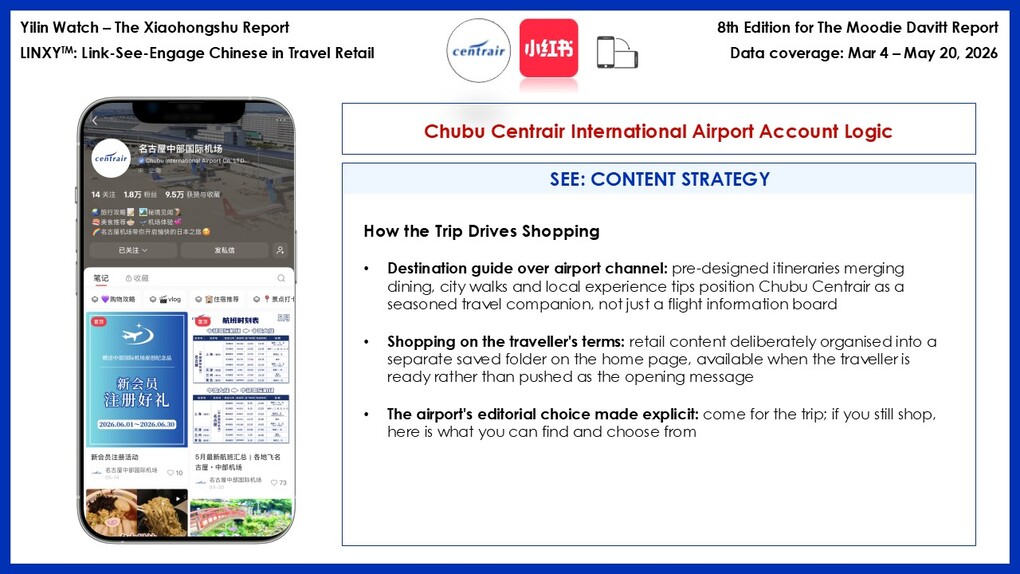
Chubu Centrair International Airport in Japan published pre-designed travel itineraries, merging dining, experience, city walks and travel tips on its Xiaohongshu account, functioning less as an airport flight information channel and more as a local destination guide.
The shopping content was deliberately organised into a separate saved folder, available when the traveller was ready for it rather than pushed as the content feed. The airport effectively said: come for the trip. If you still shop, here is what you can find and choose from.
Click here to watch the Chubu Centrair account walkthrough
A new trend of brand collaboration with national tourism organisations (NTO) is also worth highlighting. As Chinese FIT travellers search for destination experiences, NTO accounts on Xiaohongshu are attracting growing attention.
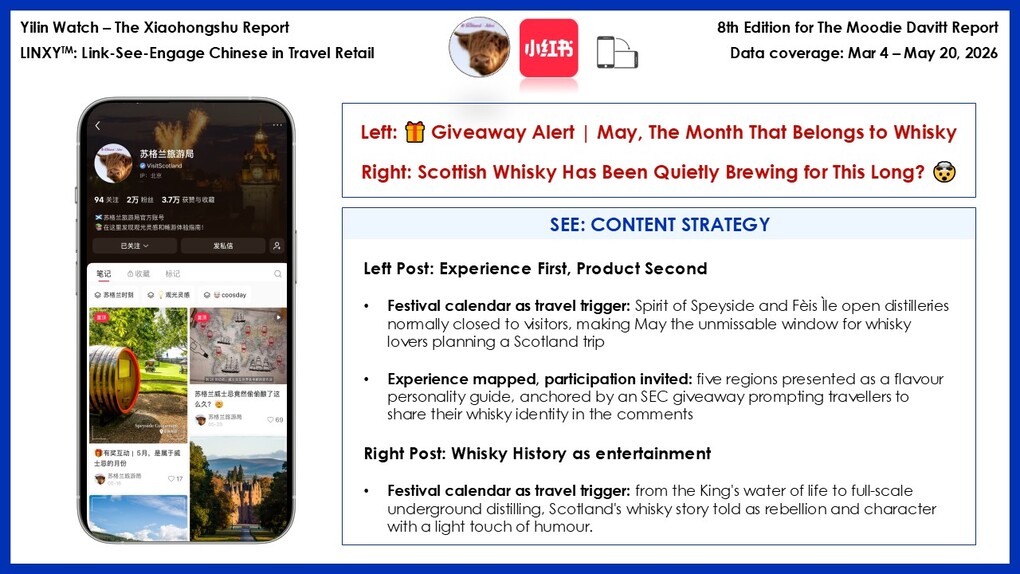
On Visit Scotland’s account, a seven-minute video introducing Scottish whisky culture attracted 66 likes within two days and was pinned to the top of the account. [Engagement figures reflect post performance within two days of publishing, as observed during the data coverage period. Screenshots captured at a later date may show higher counts.]
In parallel, a second pinned post featured an interactive SEC campaign (Save, Engage, Comment – Xiaohongshu’s primary organic amplification mechanic), framed around May as the month of whisky and developed in partnership with distilleries including The Glenlivet, Glenfiddich, Ardnahoe, Lagavulin, Galloway and Glenkinchie.
Neither post advertised a product. Both led with a world that draws the traveller’s curiosity to explore further.
Click here for the left post link
Click here to watch the SEC campaign
The content that wins in the feed today is neither retailer-centric nor brand-centric. It enters naturally into the traveller’s planning moment, with practical guidance, authentic experience-led narratives and a clear reason to include the stop in the route.
The closer an offer sits to the traveller’s real decision journey, the stronger its chance of earning a place in her shopping budget.
The new story Is ‘Spend Smarter’ not ‘Buy Cheaper’
Another significant signal on Xiaohongshu during May Golden Week is the rise of 精算式度 假, the smart-spending holiday [Source: Trend Foresee Consulting & Xiao Mingchao Trend Watch, When ‘Smart Spending’ Meets ‘Slow Travel’: 2026 May Day Mini Golden Week Consumer Trends Report, May 2026].
Today’s Chinese FIT travellers are not simply chasing the lowest prices or the biggest names. They are optimising total journey value.
This distinction matters. Accelerated by the COVID years, Chinese consumers have completed a fundamental shift in digital empowerment. When prices can be verified through a simple phone scan, and irreplaceable experience has become the number one driver to improve quality of life, every travel spending decision is tested more carefully.
The information gap has almost closed. What has changed is not desire. It is the decision process: compare first, then commit, only when the value is clear.
They are not buying less. They are choosing better.
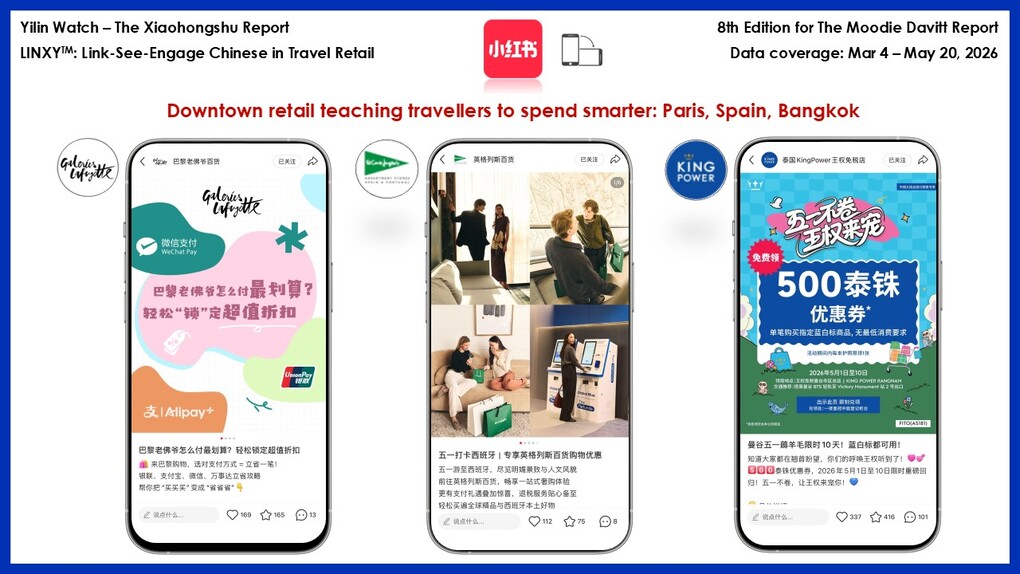
Some downtown department stores in top European destinations have clearly understood this mindset and adapted their storytelling. Galeries Lafayette in Paris states it plainly: not 教你买买买 but 帮你省省省,not a buy-more guide but a save-smarter one, walking Chinese travellers through payment combinations and offer stacking.
El Corte Inglés in Spain built its Golden Week offer around 五一打卡,专享购物优惠, inviting visitors to discover their exclusive advantages across the store.
Across Asia Pacific, the savvy traveller’s savings playbook has become the default format at every travel peak, from CDFG Sanya to King Power Thailand. None of these brands claimed to have the best prices. All of them were teaching people to spend smarter.
Click here for the post link of Galeries Lafayette Paris
Click here for the post link of El Corte Inglés Spain
Click here for the post link of King Power Thailand
For airport retail, this creates direct pressure. The old model, built on the assumption that airport duty-free stores would naturally capture impulsive purchases through savings, is losing its grip on Chinese travellers.
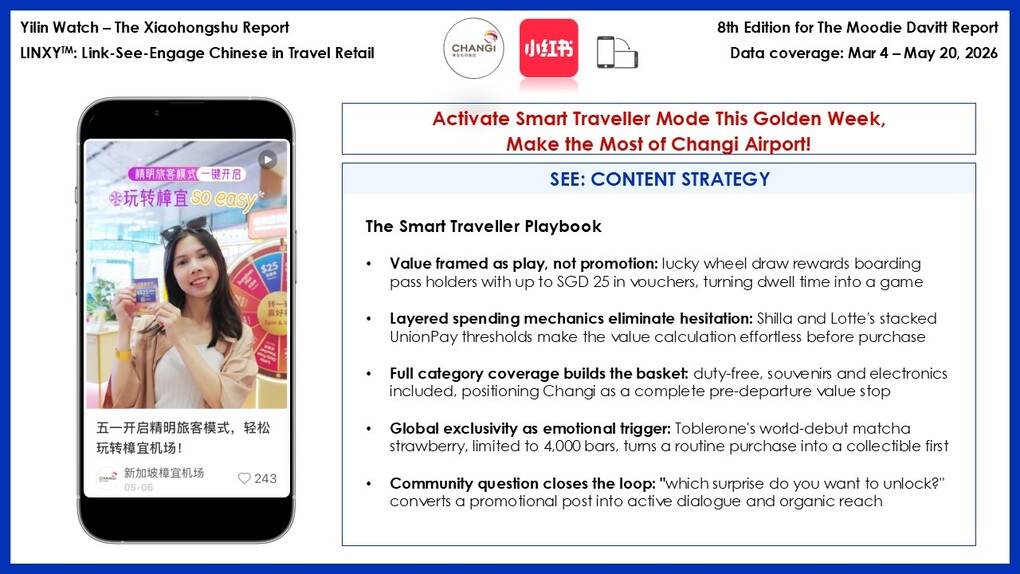
Still, some airports are answering this new challenge well. Singapore Changi Airport’s 精明旅客模式, the smart traveller model, laid out step by step every benefit available at each stage of the airport journey, making value visible and tangible before arrival. The traveller did not feel sold to. She felt prepared and understood.
The anxiety of being ripped off was removed before she even arrived. This transparency creates trust and drives genuine positive reviews. The traveller who feels informed spends with confidence. The traveller who feels uncertain walks away.
Those who felt misled after the purchase post about it, and on Xiaohongshu, that post stays and travels further than the campaign itself.
Click here for the post link
Click here for the video link
This is not consumption downgrade. It is consumption rationalisation. The traveller has already done the work. The question is whether the airport has.
For EMEA airports in particular, the lesson is clear. In a digital environment where any price claim can be tested in seconds, trust cannot be built on slogans. It is built on transparency, specificity and word of mouth.
The airport last stop must stop claiming and start demonstrating: here is exactly what you get here, here is why it is worth your time, here is what makes this stop different from every other point on your journey.
The Gap Between the Feed and the Floor
Clarity is the entry point. It is not the destination.
When a Chinese FIT traveller saves a post, notes a promotion, or screenshots a product on Xiaohongshu, she is not simply collecting information. She is building an expectation.
By the time she reaches the airport, she is no longer arriving to discover from zero. She is arriving to validate.
What she finds at the counter either confirms what the feed prepared, or breaks it. On Xiaohongshu, broken expectations do not stay private. They surface in comments, in high-liked warning posts, in AI-generated search recaps that remain visible
long after the trip is over.
This is the most consequential gap in travel retail today. Not the gap between posting frequency and engagement rate, nor the gap between Asian and European accounts.
The gap between the promise made in the feed and experience delivered on the floor.
Closing that gap demands something content alone cannot deliver: human readiness on the floor. The community manager who answered her question before she arrived in the store.
The BA who may not speak Mandarin but knows exactly how to validate a preinformed customer’s shortlist with confidence and cultural precision. The frontline team briefed in time on every layer of the current offer. These are not supporting details. They are the conversion levers that digital presence alone cannot build.
Xiaohongshu is not a display window. It is a pre-trip service desk. But a service desk only works if the people on the floor are prepared to honour what it promised. If the feed creates desire and the floor creates doubt, the sale is lost. If both speak the same language, the last stop becomes more than a point of transit. It becomes a place of confirmation and trust, and trust is what turns intent into spend.
For EMEA travel retail, earning that trust before the summer peak is not optional. It is the whole game.
The Yilin Takeaway & Conclusion
The last stop must earn its place.
For travel retail, summer 2026 will not be won by visibility alone. For Chinese outbound travellers, shopping is one layer inside a wider travel decision: a route, an experience, a cultural moment, a budget calculation, a final validation.
Across the journey, every player who removes anxiety, embeds experience-led content naturally and speaks to the traveller as a person rather than a transaction has a stronger claim on her spending budget. The opportunity must be captured earlier, explained more clearly, and delivered with more human warmth and intercultural intelligence on the floor.
Yes, Chinese travellers are becoming more sophisticated. But they also praise. When an experience is good, when a team is efficient, when a sales associate is truly helpful, patient and genuinely problem-solving, that travels far on Xiaohongshu.
They write about the store associate who solved a problem in ten minutes at six in the morning before a flight. They capture the moment and post it.
They share their surprise at hearing Mandarin from a local airline staff member at the check-in counter. They come back to the BA who helped them on their last trip. They spread the warmth of being seen, understood and helped.
That is what the last stop can still offer that no savings guide can replicate.
The next competitive edge is not only a better campaign. It lies in a frontline team ready to understand, listen, guide and convert. It is the human to human, culture to culture conversation that makes a real difference.
Ask yourself and your team: are we delivering what earns trust? ✈
{At Yilin Consulting, we design practical frontline programmes for travel retail teams, equipping Brand Ambassadors with the cultural confidence and conversation tools to convert Chinese visitors from the very first interaction.}
Contact: yilinwang@yilinconsulting.com
Yilin Wang | Founder & CEO, Yilin Consulting, Paris
Previously on Yilin Watch: The Xiaohongshu Report
Edition 5: Yilin Watch: The Xiaohongshu Report – Targeting the year-end Chinese traveller
Edition 2: Yilin Watch: The Xiaohongshu Report – Focus on Qatar Airways, Cathay Pacific and All Nippon Airways
Edition 1: Announcing a key new editorial column – Yilin Watch: The Xiaohongshu Report