


GERMANY. “I want to see every investor get three to five times their money back. I would also love to say we have created new standards for how the industry is approaching consumers.”
That’s how GHARAGE Ventures Managing Partner Lennard Niemann describes his ambitions for the Gebr. Heinemann-anchored entity in the coming years, after its first fund launched recently with €40 million in capital. He was speaking to media partners at Heinemann’s annual press conference in May.
GHARAGE, established as an innovation hub in 2019, has more recently taken on the role of an independent venture capital platform for early-stage technologies shaping the future of global travel and retail. GHARAGE operates from Berlin, Hamburg and Singapore, with Fund I based and regulated in the south-east Asian city.
A key premise is that, while air travel continues to grow, many operational areas within airports and travel retail remain under-digitalised. Collaboration with startups (already under way) helps fill this gap, focusing on automation, AI-enabled operations, digital infrastructure, travel technology services, logistics and supply chain innovation.
Fund I has around ten investors, with strategic LPs such as airports, travel retailers and brands joining as Limited Partners to gain early access to innovation.
With this initial fund, GHARAGE has already invested in several pioneering companies and technologies that address structural challenges in the travel and retail industry:
- FileAI, based in Singapore, automates document processing and reconciliation workflows, reducing friction in complex retail environments.
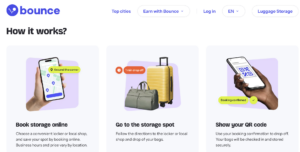
- Bounce, headquartered in San Francisco, is building a global luggage storage network. Other investors include leading US venture capital firm Andreessen Horowitz.
- Gumshoe AI enables brands and retailers to optimise their visibility across AI-generated search interfaces, positioning operators for the transition toward conversational and agent-driven commerce.

Fund I is making investments across the entire travel and trade value chain, backing companies that create tangible operational value, with a pipeline portfolio of around 30 anticipated over the next five years.
Building the investment case
Further background to the fund’s creation lies in the seven years of GHARAGE’s existence and experiences to date.
Niemann says, “Back in 2019 when GHARAGE started out as an innovation hub we saw how the latest technological wave had not really affected the business of travel retail. Yet we could see consumer behaviour changing on the one hand and technology changing on the other, both disruptive factors.
“But how do you influence change? M&A when it comes to technological innovation is too expensive while [industry] partnerships normally move too slowly.
“What we realised is that collaboration with startups, or venture clienting, is a fast and very efficient way to bring innovation to our marketplace. This is, by definition, a corporate collaborating with a young technology company to adopt innovation into their core business. But the legacy players in our industry are not really moving in this direction fast enough.”

The combination of fast-moving technology, notably AI, and the shift in consumer mindsets, means there is high potential when it comes to improving both top and bottom line, if one moves fast and efficiently in support of startups.
“Venture capital is the engine to get access to all the innovative stuff that is out there,” says Niemann.
On how the fund becomes involved with these startups, he adds, “We see around 1,000 potential companies a year that could be opportunities, of which 0.5% are investment-relevant for us.
“But another 20 to 30% of these companies are interesting for our ecosystem. And this is a profitable hook and breeding ground for the idea of building a venture capital fund.”
GHARAGE also gains access to every deal it pursues, even in a competitive market, he says.
“This is because, for the startups, we are not only delivering cash at an average of €250,000-€300,000 as an entry ticket. We are also delivering access to the industry, we are potentially delivering synergies between multiple players and extreme operational know-how through our history and corporate development.”
On the multiplier effect of driving interest from across the sector, he continues, “The more players from within our travel retail value chain that join, the more capital we have, the more access to different players and the more synergies we can build, which is the main reason why we are looking for (and have some) investors among wholesalers, operators, suppliers, distributors, logistics providers, airports, airlines and potentially even hospitality companies.”
Building on the case for investing in the next wave of industry change, through this and future funds, Niemann says, “First, we have to detach ourselves from the thought that passenger growth will continue to determine industry growth.
“Second, this next technology wave will heavily influence how people shop. The corporates who come first will most probably have a big advantage in terms of creating bigger margins.
“Lastly, it is worth thinking about how you turn innovation into a profit centre instead of building another cost centre for innovation.”
The returns at three to five times investment should appeal, he adds, as should an anticipated high rate of success.
“When the Internet hype came along, fund investments were mostly structured so that two or three out of 100 would return on behalf of the entire fund,” he says. “Our fund structure is different. We do not expect to have a fallout of say 80%, with another 17% doing OK and then 3% doing very well. We are expecting a higher level of success at lower multiples to bring the returns.”
Niemann concludes: “This an exciting movement for the industry and it also underlines how Gebr. Heinemann is both thinking about partnerships and rethinking the traditional travel retail model.” ✈