
 |
ACI’s Andreas Schimm announces the December and full-year results at the Delhi T3 conference yesterday |
INTERNATIONAL. Airports Council International (ACI) has reported a +5.3% rise in global airport passenger traffic in December 2009 compared to the previous year.
 |
Both international passenger traffic (up by +5.6 %) and domestic traffic (up by +5.2 %) were boosted by strong performance across Asia Pacific (+15.7 % international; +14% domestic). All regions saw increases, except for North America which remained flat.
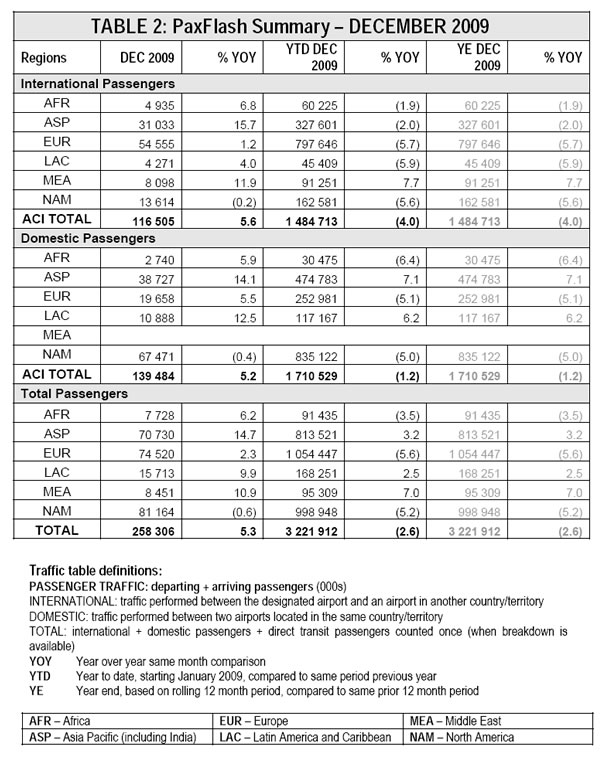 |
December’s results* showed “clear signs of renewed passenger traffic demand at many airports worldwide”, ACI said. International traffic grew faster than domestic traffic at most airports in China. Traffic in India, both domestic and international, surged in December (Delhi +32%, Bangalore +37%, and Mumbai +29%, with Mumbai domestic traffic increasing by +39%).
 |
Similarly, traffic growth is on the mend in Russia driven by domestic traffic growth at the Moscow airports ranging from +21% to +40%.
ACI World Director of Economics Andreas Schimm commented: “Looking at full year 2009, global traffic results were much better than expected early in the year, finishing at just 2.6% below 2008. Fears that third quarter traffic would decline substantially did not materialise, and the stabilisation seen provided a platform for remarkable fourth quarter growth.
“Even taking into account falling global traffic demand in late 2008 and the impact on Asia Pacific results in 2008 of the closure of the Bangkok Suvarnabhumi Airport due to a political siege, which slightly inflate the percentage growth comparison, passenger and freight results are very promising.”
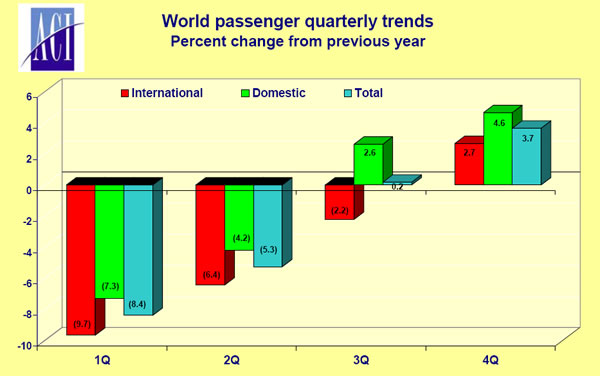 |
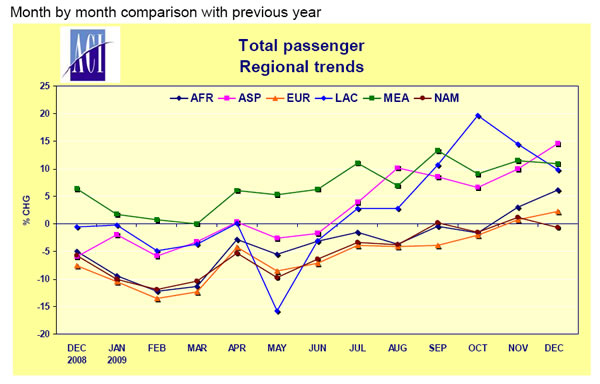
Overall, global figures were boosted by strong domestic traffic in China, India and Brazil where volumes surged in the second half of 2009. For the full year, traffic results highlight a split between the two largest aviation markets (North America and Europe) each of which lost more than -5% traffic in 2009, and the continued expansion of Asia Pacific, Latin America-Caribbean and Middle East markets.
Top performance results in the international category were seen at Dubai (+9.6%), Kuala Lumpur (+8.8%) and Istanbul (+7.3%), the only airports with more than 10 million passengers per annum to register growth in 2009. Airports in Africa suffered a moderate -3.5% setback for the year, mainly caused by declines in domestic traffic whereas international shrank only marginally.
 |
NOTE: ACI has 575 members who operate over 1633 airports in 179 countries and territories. Passenger statistics are based on a significant sample of airports that provide regular monthly reports to ACI. They represent approximately 60% of total passenger traffic and 70% of total freight traffic worldwide. Commentary, tables and charts are based on data submitted by participating airports.
Advertisement |
MORE STORIES ON ACI
ACI Europe event to focus on key industry threats
ACI Europe partners with ETRC for vital Trading Conference
ACI Europe unveils strong line-up for Trading Conference
Global airport passenger traffic continues recovery with +4.2% rise in November, says ACI