
 |
“Commercial or non-aeronautical sources of income such as retail concessions and car parking contribute to the diversification in an airport’s income portfolio and provide an additional cushion during adverse economic times.“ |
Angela Gittens Director General ACI World |
INTERNATIONAL. Airports Council International (ACI) this week released the 20th edition of the Airport Economics Report, outlining the industry’s Key Performance Indicators for the financial year 2014.
Crucially, it noted that combined revenues from commercial and non-operating activities accounted for 45% of revenue at the world’s airports and grew by +7.2% year-on-year.
Overall, non-aeronautical revenues contributed 40.4% of industry incomes, compared to aeronautical (55.5%) and other non-operating revenues (4.1%).
Global airport revenue per passenger was US$21.22, with non-aeronautical revenue per passenger at US$8.58 in 2014.
The study features data from over 800 airports and analyses aeronautical and commercial revenues. The link between airport size and financial performance is also examined.
“As an integral part of the air transport value chain, it is essential to monitor the economic aspects of this dynamic industry for evidence-based decision making,” said ACI World Director General Angela Gittens. “ACI’s Key Performance Indicators continue to be the industry reference for a thorough understanding of the financial health of the airport industry.”
ACI noted: “There are two forces at play in the global economy, which have pushed the pendulum in opposite directions. As advanced economies get back on course, the emerging market slowdown has resulted in overall moderate growth levels in global output. Regardless, passenger traffic remained resilient in the face of the global uncertainties that beleaguered many of these economies over several years. International tourism, in particular, was irrepressible in 2014 and 2015, even considering the geopolitical risks that persisted in certain parts of the world, such as Eastern Europe and the Middle East. The Ebola outbreak also presented significant challenges to the aviation sector. Notwithstanding, by and large, the international traveller appears to have discounted these risks.”
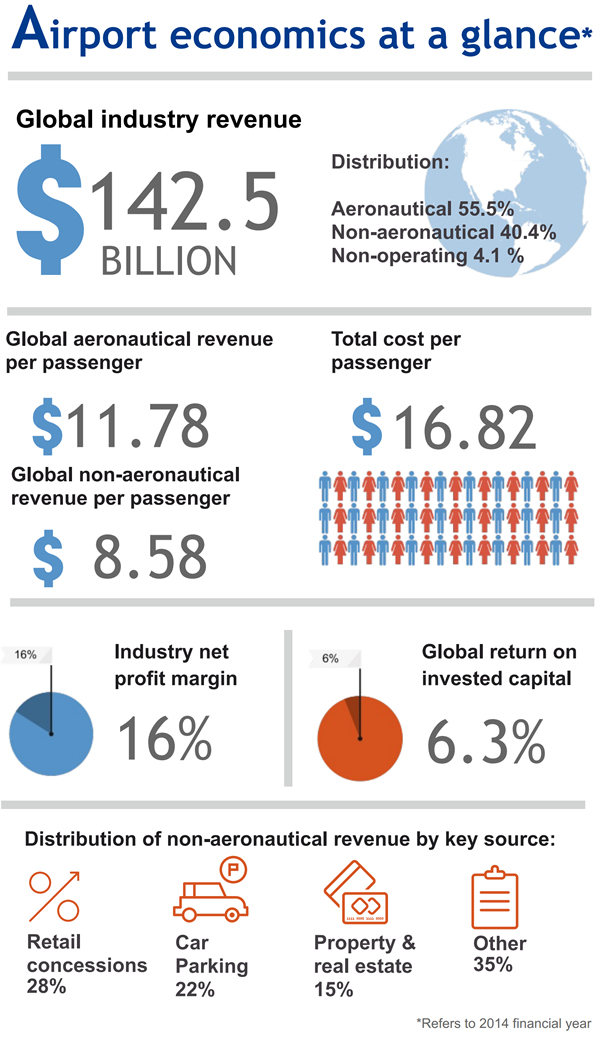 |
How airport revenues worldwide broke down in 2014 |
Based on the 2014 financial year, airport revenues experienced strong growth compared to the previous year. Although there were regional variations in financial performance, the recovery in the Euro area and the USA, combined with the continued buoyancy of aviation in emerging markets, translated into gains in airport revenues, said ACI.
Industry revenues as a whole grew by +8.2% from 2013, reaching over US$142 billion in 2014. ACI added: “Many airports across the globe have moved towards a business model that charges the travelling end user for their services through passenger-based revenue schemes. On the aeronautical side of the business, over 55% of every dollar was generated from passenger-related charges as compared to other aeronautical sources of income such as aircraft-related revenues.”
“The airport revenue model is becoming increasingly diversified and sophisticated,” added Gittens. “Airport operators have moved beyond being mere infrastructure providers for aeronautical activities to varied and far-reaching enterprises. Commercial or non-aeronautical sources of income such as retail concessions and car parking contribute to the diversification in an airport’s income portfolio and provide an additional cushion during adverse economic times.
“The combined revenues from commercial and non-operating activities account for 45% of the all revenue streams and grew by +7.2% in 2014,” she continued. “While European airports hold the highest proportion of these revenues relative to other regions, much of the revenue growth is originating from airports located in the emerging markets of Asia-Pacific, the Middle East and Latin America-Caribbean, where the highest growth in commercial revenues in being posted.
“Nevertheless, certain realities persist that are related to the economics of airports and economies of scale,” Gittens concluded. “The challenge remains that most airports in the world are small, with high traffic volumes concentrated in only a handful of airports. Therefore, the airport industry faces a conundrum; although the airport industry as a whole appears to be profitable on the aggregate level, with returns on invested capital in the realm of 6.3%, the majority of airports are actually in the red on their financial statements.
“Thus, developing the necessary strategy to enhance traffic growth is fundamental in generating a positive economic return. It is important for all stakeholders in the air transport value chain to work together to reap the benefits and the multiplier effects of increased trade and tourism.”