
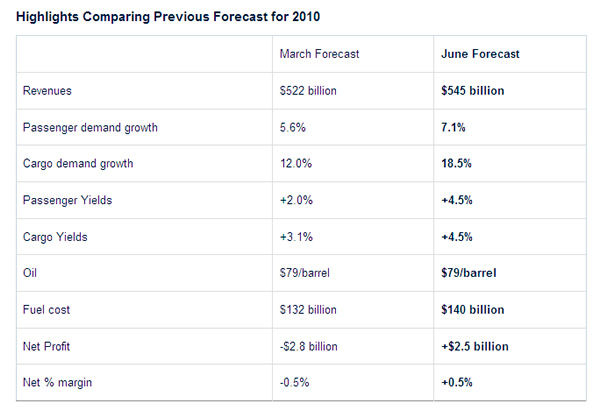
INTERNATIONAL. The International Air Transport Association (IATA) expects airlines worldwide to post a profit of US$2.5 billion in 2010. This is a major improvement compared with IATA’s previous forecast released in March of a US$2.8 billion loss.
Industry revenues are forecast to be US$545 billion in 2010. This is up from the US$483 billion in 2009, but still below the US$564 billion achieved in 2008.
IATA Director General and CEO Giovanni Bisignani said: “The global economy is recovering from the depths of the financial crisis much more quickly than could have been anticipated. Airlines are benefiting from a strong traffic rebound that is pushing the industry into the black. We thought that it would take at least three years to recover the US$81 billion (-14.3%) drop in revenues in 2009, but the US$62 billion top line improvement this year puts us about 75% on the way to pre-crisis levels.”
 |
Giovanni Bisignani: “The global economy is recovering from the depths of the financial crisis much more quickly than could have been anticipated.” |
He added: “The US$2.5 billion profit comes with some important health warnings. First, this represents a net margin of just 0.5%, which is a long way from sustainable profitability. Second, a major part of the global industry is still posting big losses. A stagnating economy, strikes, natural disasters and a currency crisis have left European carriers struggling with an anticipated US$2.8 billion loss.”
Highlights of the revised forecast include:
Traffic: Passenger traffic is forecast to grow by +7.1% in 2010 while cargo traffic will expand by +18.5%. This is significantly better than the previous forecast growth of +5.6% and +12.0% respectively. Over the first quarter the industry was growing at an annualised rate of +9% for passenger and +26% for cargo.
Yields: Yields are now forecast to grow by +4.5% for both cargo and passenger businesses. This is a significant improvement from the previously forecast yield growth of +2.0% in passenger markets and +3.1% for cargo. The +4.5% rate is just ahead of consumer price inflation. This is contributing strongly to the +13% rise in revenues forecast for 2010. Despite the increase, revenues remain -4% below their 2008 peak.
Load Factors: New capacity will be added to the global system as a result of the 1,340 aircraft that are scheduled to join the fleet in 2010. Of these approximately 500 are replacement aircraft; the rest will be new capacity.
Ash: Air space closures following the eruption of an Icelandic volcano dented the recovery in April as a result of over 100,000 flight cancellations associated with European markets over six days. While uncertainty remains with the potential for future eruptions, it appears that this was a short-lived shock. Early May figures show a rebound in traffic for European carriers.
Premium Travel: Despite earlier fears that the financial crisis would result in a structural change to the premium market, it now appears to be recovering cyclically in many regions – alongside improvements in global trade. Premium travel was rebounding at an annualised growth rate of +20% over the first quarter and economy travel is now back to pre-recession levels. In the absence of a strong improvement in consumer confidence that would be needed to drive leisure traffic growth, it would appear that business travel also supported some of the recovery in the economy cabin, said IATA.
Fuel: Fuel costs continue in line with the previous forecast expectations. IATA maintained its expectation of an average annual oil price of US$79/barrel (Brent) in 2010.
 |
Regional differences in airline performance sharpened with this forecast, noted IATA. “The recovery from this crisis is asymmetrical. Worsening conditions in Europe are in sharp contrast to improvements in all other regions,” said Bisignani.
Asia Pacific carriers continue to benefit from strong regional growth. Against a global GDP growth expectation of +2.9%, the Asian economy (excluding Japan) is expected to grow by +7% this year. China will outpace that with an expected +9.9% GDP expansion. As a result the region’s carriers are expected to deliver the largest profit at US$2.2 billion. This is more than double the US$900 million previously forecast in March and a major reversal from the US$2.7 billion loss in 2009.
North American carriers are expected to return a profit of US$1.9 billion. This is a major reversal from the previously forecast US$1.8 billion loss, and the US$2.7 billion that the region’s carriers lost in 2009. The US economy is growing with a +3.3% GDP expansion. Carriers are improving efficiencies as a result of demand growth, capacity cuts and domestic mergers.
Latin America: Latin American carriers will show a profit of US$900 million, up slightly from the US$800 million previously forecast. Having posted a US$500 million profit in 2009, Latin America will be the only region to post two consecutive years of profit. The region’s commodities are closely linked with Asian growth and supported by a +3.9% GDP expansion this year.
Middle Eastern carriers are expected to post a profit of US$100 million – their first since 2005. This is significantly better than the previously forecast US$400 million loss and the US$600 million that the region’s carriers lost in 2009. GDP growth of +4.3% is outstripping the global average and Gulf carriers continue to gain market share through their hubs for Europe to Asia Pacific traffic, even as capacity is being added at a more cautious rate.
African carriers are expected to post a US$100 million profit, their first since 2002. This reverses the US$100 million loss previously forecast in March and the US$100 million that the region lost in 2009.
Europe will be the only region in the red with a US$2.8 billion loss. This is a downgrading from the US$2.2 billion loss previously forecast in March, although it is an improvement on the US$4.3 billion that the region lost in 2009. GDP growth of +0.9% is not enough to support a recovery and the currency crisis clouds the future with uncertainty. Moreover 70% of the US$1.8 billion loss in revenue as a result of the volcanic ash crisis was borne by European carriers. A series of labour strikes and strike threats have also affected the region’s performance.
“Seeing black on the bottom line is a great achievement. The resilience of the industry has been strengthened by a decade of cost cutting, restructuring and re-engineering processes. IATA’s programmes have contributed to this with US$47 billion in cost savings since 2004 with efficiencies in safety auditing, fuel management, infrastructure costs, and Simplifying the Business,” said Bisignani.
“But even with all our hard work, the result is just a 0.5% margin that does not even cover our cost of capital. The industry is fragile. The challenge to build a healthy industry requires even greater alignment of governments, labour and industry partners. They must all understand that this industry needs to continue to reduce costs, gain efficiencies and be able to re-structure itself if it is to be sustainably profitable. We must all be prepared for a greater change,” said Bisignani.