 |
INTERNATIONAL. The Moodie Report presents the second in a new series in association with The Design Solution dedicated to the important, but often misunderstood, concept of Sense of Place. Here, The Design Solution Founder and Director Robbie Gill looks at the role food & drinks can play as well as highlighting Mumbai T2 as a showcase for India.
The opening instalment of this series, which is also running in every issue of The Moodie e-Zine, asked whether travellers really know, understand or appreciate where they are in the world – through the sights, sounds and smells of the airport?
The Design Solution Founder and Director Robbie Gill said: “A Sense of Place entices the traveller and gives them an emotional experience of travelling through somewhere special, connecting with the environment.
“In launching this new series of articles I want to show that Sense of Place is increasingly important as an element of the travel experience, both in what the traveller is seeking from the airport encounter and what we as an industry can do to deliver those needs. It is an important concept that potentially not only enhances the traveller experience but can also support commercial performance.
“To help us develop a shared understanding for our industry, we will examine the background to the concept of Sense of Place, including the strategies adopted across the travel sector by airports, retailers, brands, food & drinks providers, airlines and cruise & ferry operators.”
He added: “There are many mundane locations that struggle to add any positive memories to carry onboard. However, there’s no doubt that a select portfolio of terminals (including retail encounters) truly inspires a distinct Sense of Place, a feeling that lifts the mood and suddenly makes the journey less of a process and more of an experience – creating an attachment, a connection.”
Gill singled out Billund, Xi’an Xianyang and New Delhi airports as examples of inspired Sense of Place. Here, he explains the importance of local food & drinks on the traveller mindset and tells us why Mumbai T2 offers a wonderful showcase for India.
He says: “There are clearly many other ways to develop Sense of Place, such as F&B and of course, don’t forget the staff – the local people who can truly personalise the experience – and these are two areas that surely demand their own article in this series.
“For now, I will simply say that F&B is an obvious opportunity to convey a truly local Sense of Place but it is perhaps surprising how weakly this is exploited at many airports. Positive examples include Heinemann’s local food presentations, which are always engaging and original with an added touch of fun, and the FAB award-winning summer food festivals at Copenhagen.
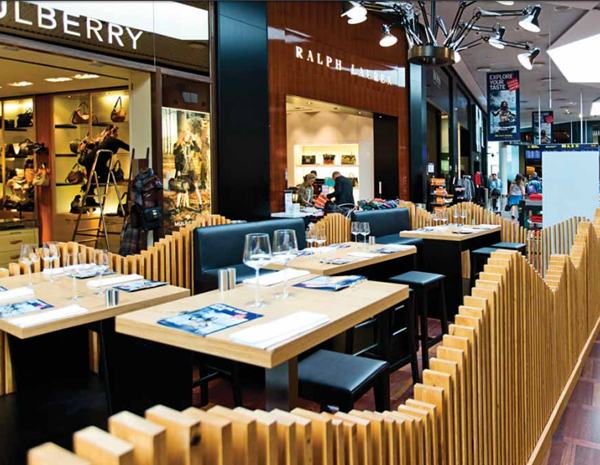 |
A taste of Denmark: Gill highlights Copenhagen Airport’s Nordic Chefs pop-up restaurant concept for delivering surprise, theatre and local feel |
“The placing (overnight) of a stylish pop-up restaurant right there on the Copenhagen concourse, presenting a series of menus from the region’s top chefs, gives travellers a true flavour of Denmark and wonderful memories of the airport.
“In-store service is an aspect that travel retail has grasped as a major tool in driving performance, but staff interaction across the chain of communication with the traveller is a uniquely influential factor in creating (or destroying!) a Sense of Place.
“At Abu Dhabi Airport and onboard Etihad, for example, I’m invariably delighted at the quality of customer service, making the interconnected Abu Dhabi experience feel welcoming, familiar and authentic.
“With personal experience being an integral part of the bid brief for Abu Dhabi Midfield, we can expect to see sector-leading examples in practice when the Midfield Terminal opens.
“As such, in seeking to define the concept of Sense of Place, perhaps we can work from the premise that its holistic nature means that a Sense of Place can be supported, or damaged, by almost any element of the traveller’s interaction within the airport space?
“Some elements e.g. architecture, the design of interior spaces, retail encounters, staff etc. are clearly likely to be the biggest influencers but I hope this series of articles will dig deeper.
“In my view, Sense of Place is about much more than creating inviting, engaging and memorable spaces and encounters; but it is also potentially a powerful tool for influencing traveller behaviour, including their retail behaviour.”
Pragma Consulting’s Alex Avery assesses that potential later in this article.
Showcase – Mumbai Chhatrapati Shivaji International Airport T2, India
India seems to be leading the airport world’s centre of artistic expression. At Mumbai Chhatrapati Shivaji International Airport T2, GVK has developed an extraordinary Sense of Place through the huge scale and quality of its constantly evolving artistic installations – the centrepiece being “˜Jaya He’, a gigantic art wall four floors high and a total length of over three kilometres!
In creating this mesmerising series of museum-quality displays throughout the terminal, incorporating historic and contemporary themes, over 7,000 artefacts were sourced from across India, many of which were meticulously restored.
The display themes celebrate many aspects of Indian culture, from “˜India Seamless’, depicting the myths, histories and popular culture of the regions, to “˜India Global’, celebrating the nation’s contemporary urbanscapes and lifestyles.
Local vision
Of course, artwork in airports is not new (Amsterdam Schiphol, Paris CDG, San Francisco, Toulouse, Toronto Pearson and several others all have long-standing programmes), but Mumbai has taken the idea to a whole new level, innovating in how artwork can be shared with the public.
For example, major works of art and renowned Indian artists are treated equally with craft displays or works by unknown artists, thus mixing old and new, rural and urban, traditional with contemporary. The resulting riot of colours and experiences is an enthralling experience on every visit to the terminal.
 |
Centre of artistic expression: Mumbai Chhatrapati Shivaji International Airport T2 |
The Mumbai T2 encounter was founded on the vision of GVK Vice-Chairman Sanjay Reddy in seeking to present “the expanse, depth and beauty of Indian art” in a terminal project that, tellingly, actually demolished more than it built!
Sanjay began by approaching artist and curator Rajeev Sethi, not to simply display artwork but to actually integrate art into the very architectural framework of the new terminal. Interestingly, Sanjay was aiming the art at two audiences – the foreign visitor, of course, but also at strengthening the awareness and pride of Indian nationals in their culture, making this a wholly inclusive Sense of Place shared by all.
Sanjay Reddy’s vision has been achieved in the most extraordinary way and gives the traveller an eclectic but cohesive art collection from which to select their own unique selection of favourite works, thus giving Mumbai T2 a Sense of Place that is uniquely tailored – and interpreted – by each individual traveller.
Here’s what he has to say: “India is a country with rich history, culture and heritage. This aspect is, in particular, reflected in its art and craft. However, during the last few decades, modern buildings have not been able to capture these aspects into their design. Therefore, I felt it was critical that our new Terminal 2 (T2) at Mumbai showcases the beauty of Indian art and design.
“To implement this strategy we used the peacock feather as the design inspiration for the architecture of the building. Further, we implemented a 3km long art programme called “˜Jaya He’ which showcases art from every single region of India. The purpose of this design strategy was not only to showcase to the world about India’s beauty but also to remind Indians, especially the next generation, about the beauty that lies within our country.
“Today when travellers pass through T2, we hope that they will be impressed with what India can offer and take back a small part of it with them. We hope that this would also influence Indians to bring Indian design into their life in whatever shape or form. We also believe that T2 will influence all new airports globally to bring the Sense of Place into the centre stage of their design strategy.”
Fostering a commercial Sense of Place…
By Alex Avery*, Managing Director, Airports, Travel & Commercial Spaces, Pragma Consulting
The architectural vision and design of a terminal can certainly support Sense of Place but I think there are many more smaller components that then enable us to humanise these huge spaces and develop a more emotional component built around character and experience.
As such, Sense of Place goes well beyond the envelope of the architecture, regardless of the scale or its “˜wow’ factor. I think it is driven much more by focusing down into a high level of detail in the execution of fit-out of the retail spaces and reaching just about every touchpoint of the passenger journey.
In the retail arena this is absolutely vital as the key brand selections are inevitably dominated by the same names at each airport/location, making it critical to try to develop a differentiated experience through elements such as the service proposition, customer experience, retail offer, product selection (especially in gifting, souvenirs) and new/exclusive presentations etc.
Yes, great architecture certainly helps but that’s really just a backdrop to the passenger experience that is the prime engine for creating a genuine and sustained Sense of Place.
Airports are brands and they have moved rapidly from being functional processing environments and now face intense commercial imperatives that force them to compete much more strongly, including a Sense of Place as a point of differentiation.
Many have realised the need to develop new strategies in a holistic approach that examines all the components and touchpoints of the passenger journey and helps them to create a distinct brand personality for their airport, inherently linked to creating a Sense of Place.
The more coherently the strategy is developed and executed across the airport the more powerful and memorable the passenger experience will be – and potentially more impactful on commercial performance. This approach isn’t all about new airports, it’s something that can be adapted at any size of airport and doesn’t need to be a huge capex commitment.
A space can be transformed by something as simple as a local art installation or a mural to revitalise a dull wall, instantly adding vitality and life. In particular, as airports become more efficient and automated, the human touchpoints are even more crucial as these are the most memorable aspects of the airport experience.
As such, even relatively simple factors such as staff uniforms and the way that staff are trained to greet the traveller can instantly enhance the experience. This human/social aspect is so important and is further emphasised by the fact that F&B is another hugely influential factor.
The right F&B offer includes obvious opportunities to present a unique local proposition, both in design and menus and in gifting/souvenir options, of course, and an experience of truly local hospitality and culture.
At Pragma UK we carry out intensive research into passenger satisfaction, including their perceptions of the environment. But we’re now looking at incorporating much closer investigation of the traveller assessment of factors such as the character and identity of the location – as these will certainly influence their overall assessment of the airport and potentially affect their retail behaviour.
We need to know what they’re thinking – Sense of Place may well be as important as long-established factors such as value for money.
Developing an effective Sense of Place is not simply about making the passenger feel comfortable in the environment. Done correctly it can help shift their behaviour, including those who don’t engage with the retail proposition such as frequent flyers who feel that all airports are the same and there is nothing new or original for them to discover.
*Alex Avery is a specialist in commercial space optimisation and retail strategy and he believes that the industry needs to develop a clearer grasp on the issue of Sense of Place.