


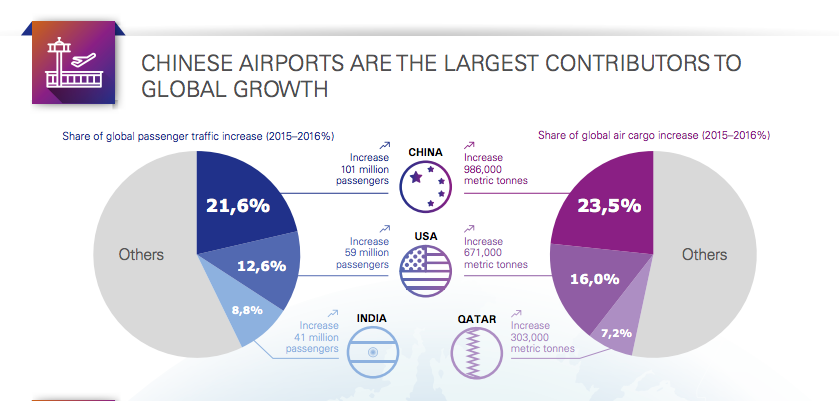
INTERNATIONAL. Chinese airports are the largest contributors to global air traffic growth, according to Airports Council International’s (ACI) latest World Airport Traffic Report. They accounted for a 21.6% share of the global passenger traffic increase from 2015 to 2016 – equal to 101 million travellers.
Growing incomes, a burgeoning middle class and peaking working age populations across emerging markets and developing economies have contributed to a rise in the propensity to travel – key factors behind China’s contribution to global air traffic growth and indicators for the rise of other populous Asian countries.
The report, which analyses traffic data from over 2,400 airports in 170 countries worldwide, found the United States (12.6%) and India (8.8%) followed as the next largest contributors to global air traffic growth.
The top three contributors to global passenger traffic growth by country share are:
- People’s Republic of China – 101 million increase in passengers representing a 21.6% share of the global increase
- United States – 59 million increase in passengers representing a 12.6% share of the global increase
- India – 41 million increase in passengers representing an 8.8% share of the global increase
“The Chinese contribution alone represented an increase of over 100 million passengers in a single year, equivalent to the total annual traffic of Atlanta-Hartsfield (ATL), the world’s busiest airport in the United States,” said Angela Gittens ACI World Director General.
Several other Asian countries are also home to some of the fastest growing airports in the world as aviation trends shift to the East, capitalising on the demographics of countries such as India, Indonesia and Vietnam.

ACI’s Emerging Aviation Market Index, which tracks 19 high-growth emerging markets that have a significant critical mass of passenger and air cargo traffic, accounts for 38.5% and 33.9% of global traffic respectively.
India, Indonesia and Vietnam have achieved double-digit growth on an annualised basis since 2006 and are poised to grow even more in the future, subject to infrastructure development. Similarly, countries like the United Arab Emirates, Qatar and Turkey, home to global connecting hubs, have experienced exponential growth in under a decade, according to ACI.

“85% of the world resides in emerging markets and developing economies. China and India alone represent over 35% of the world’s population. Growing incomes, a burgeoning middle class and peaking working age populations in some of these markets has translated into the rapid rise in the propensity to travel. Thus, it is no surprise that China, the most populous country on the globe, was the leading contributor to global growth in passenger traffic in 2016,” Gittens concluded.
Airports located in emerging markets and developing economies continue to make robust gains in passenger traffic with year-on-year growth of +8% in 2016. This growth was around+8.5% on an annualised basis for the period from 2006 to 2016.
Airports located in emerging and developing Asia are among the fastest growing in the world with passenger traffic increasing +10% on an annualised basis from 2006 to 2016.
In 2016, airports located in ASEAN-5 countries (Indonesia, Malaysia, the Philippines, Singapore, and Thailand) saw passenger traffic jump +12.8% compared to the previous year.
With 1.7 billion passengers, BRICS countries (Brazil, Russia, India, China and South Africa), which represent 21.7% of global passenger traffic, achieved strong growth of +8.2% in passenger traffic. MINT countries (Mexico, Indonesia, Nigeria and Turkey) also achieved robust traffic growth, with +5.5% increase in passenger traffic in 2016.