


EUROPE. Airport passenger traffic in Europe climbed by +2.2% year-on-year in July – the weakest performance in the month for more than five years – according to new figures released by Airports Council International (ACI) Europe. This rise was less than half the growth reported in June (+4.7%), and represents the lowest monthly increase so far this year.
ACI Europe Director General Olivier Jankovec said: “July marked a significant slowdown for Europe’s airports. Passenger traffic is no longer defying economic gravity and the performance gap with freight traffic is narrowing. Beyond economic and geopolitical factors, this reflects airlines being much more cautious about capacity growth and new route openings. ATM inefficiencies, fuel and labour costs, the grounding of the B737MAX and aircraft delivery delays are all adding to demand pressures.
“While these demand pressures are mainly driven by economic factors, the fact that the slowdown comes primarily from a fall in domestic passenger traffic (-1.5%) may be pointing to a nascent impact of changing attitudes towards air transport – as a result of the Climate Emergency.”
At EU airports, which also posted sluggish +2.2% growth, Austria (+14.1%) and Latvia (+13%) were alone in achieving double-digit increases. Other airport markets significantly outperforming the EU average in July were Portugal (+7%), Finland (+6.5%), Hungary (+6.1%), Malta (+5.3%), Croatia (+5.1%), Romania and Slovenia (+4.4%).
Meanwhile, a number of EU national markets registered passenger traffic declines including Bulgaria (-8.8%), Slovakia (-5.3%), Sweden (-3.8%), Lithuania (-3.2%), Denmark (-0.9%) and the Netherlands (-0.1%). Flat or weak growth was reported by ACI Europe for Luxembourg (0%), the UK (0.1%), Greece (0.5%), and Germany (+1.3%).
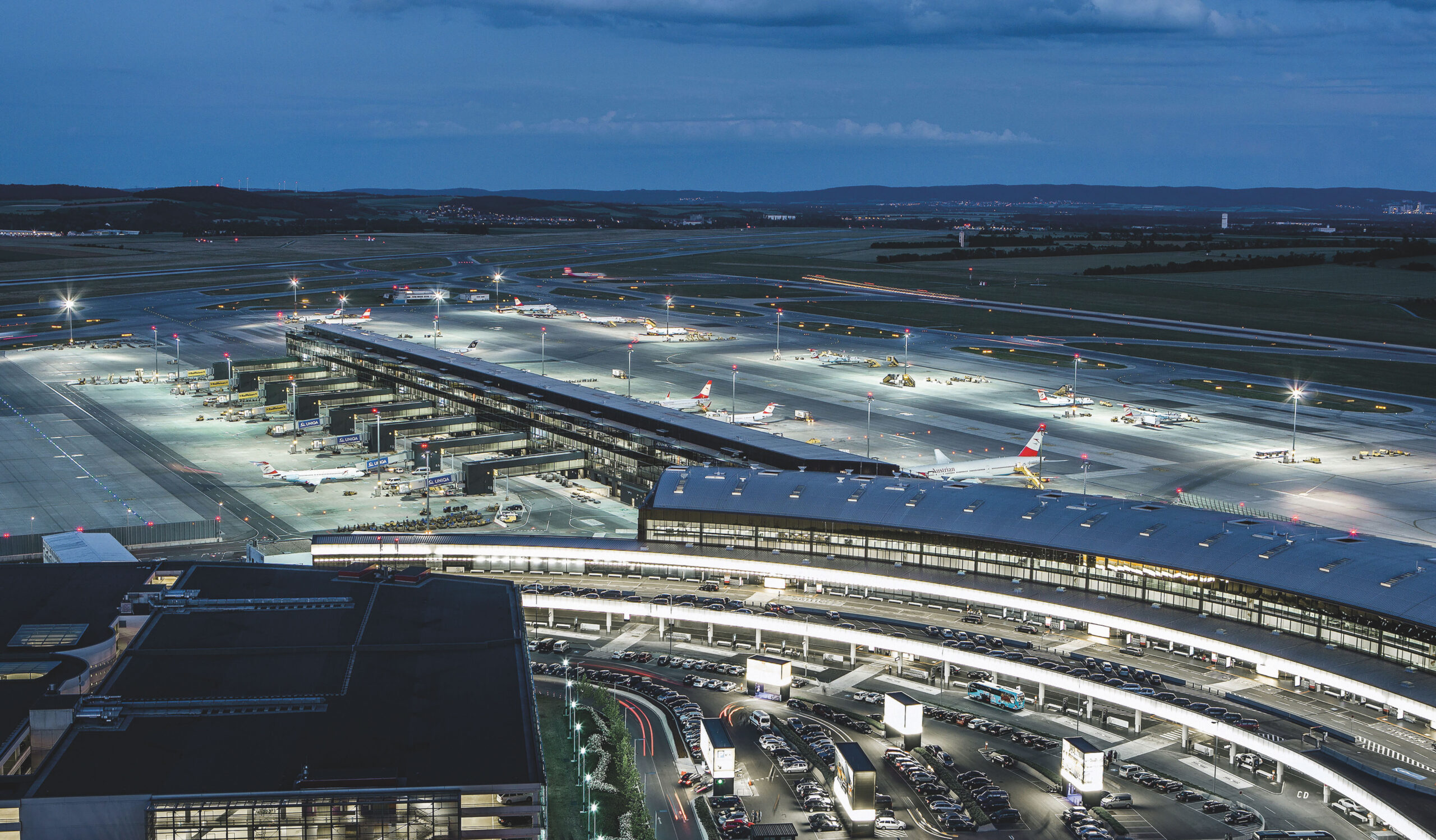
Among capital and larger EU airports, the biggest risers were Vienna (+15.8%), Riga (+13%), Milan Malpensa (+12%), Lisbon (+7.8%), Madrid-Barajas (+7.5%), London Luton (+6.7%), Budapest (+6.1%) and Helsinki (+5.7%).
Growth in the non-EU airport market was closely aligned to the EU result, at +2%. The overall figure was dragged down by a sharp decline at Icelandic airports of -29% (following the bankruptcy of WOW and severe airline capacity adjustments, ACI Europe observed). However, the only other non-EU markets not reporting growth were Georgia (-7.4%), Turkey (-0.2%) and Norway (0%).
The non-EU standout performers were Ukraine, Bosnia-Herzegovina, Albania and Belarus, all of which posted double-digit growth.
The biggest non-EU passenger growth figures came from Kyiv (+25.6%), Kharkhiv (+25.1%), Sarajevo (+13.5%), Tirana (+11.4%), Antalya (+11.3%), Minsk (+10.8%) and Moscow Sheremetyevo (+10.2%).
The ‘Majors’ (top five European airports) recorded marginal passenger traffic growth in July, at +0.2%. Only Paris CDG (+3.9%) and Frankfurt (+0.9%) were positive, while Amsterdam Schiphol (-0.7%), London-Heathrow (-0.8%) and Istanbul (-2.1%) saw passenger volumes fall.
Smaller regional airports (with less than 5 million passengers per annum) were the hardest hit by the overall slowdown. They posted a fall of -0.9% in passenger traffic and 53% of them lost passenger traffic in July, compared to an industry average of 44%.
Larger regional airports as well as those serving popular tourist destinations did, however, post some significant gains. They were led by Zadar (+27.2%), Krakow (+25.8%), Seville (+20.6%), Nantes (+16.4%), Brest (+13.7%), Bordeaux (+13.4%), Oporto (+12.6%), Bari & Brindisi (+10.8%) and Naples (+10.6%).
Group top performers
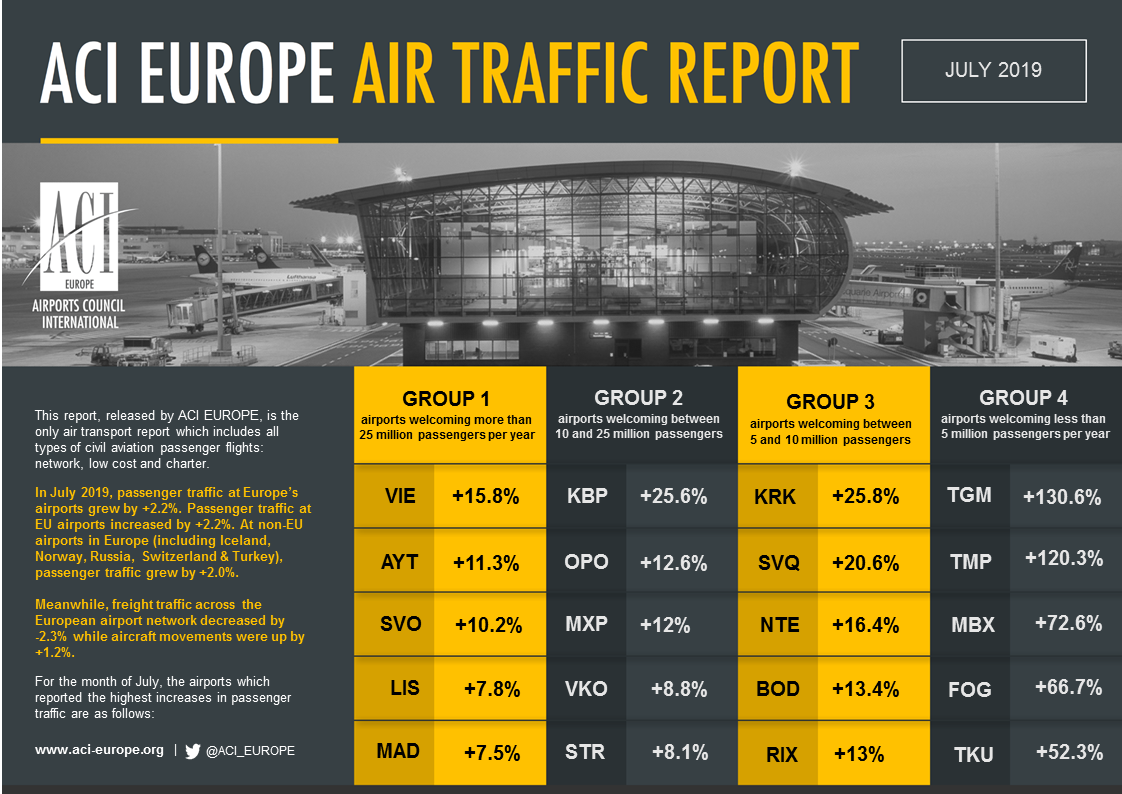
In July, airports with more than 25 million passengers per year (Group 1), 10-25 million (Group 2), 5-10 million passengers (Group 3) and under 5 million passengers per year (Group 4) reported an average adjustments of +2.1%, +3.9%, +1.6% and -0.5% respectively.
Under this measure, the airports that reported the highest year-on-year increases in passenger traffic during July 2019 were:
GROUP 1: Vienna (+15.8%), Antalya (+11.3%), Moscow Sheremetyevo (+10.2%), Lisbon (+7.8%) and Madrid-Barajas (+7.5%)
GROUP 2: Kyiv Boryspil (+25.6%), Porto (+12.6%), Milan Malpensa (+12%), Moscow Vnukovo (+8.8%) and Stuttgart (+8.1%)
GROUP 3: Krakow (+25.8%), Seville (+20.6%), Nantes (+16.4%), Bordeaux (+13.4%) and Riga (+13%)
GROUP 4: Targu Mures (+130.6%), Tampere (+120.3%), Maribor (+72.6%), Foggia (+66.7%) and Turku (+52.3%)