


CANADA. The Frontier Duty Free Association (FDFA), which represents Canada’s land border duty free industry, is calling on government to introduce measures to help the sector survive the long-term store closures forced by the COVID-19 crisis.
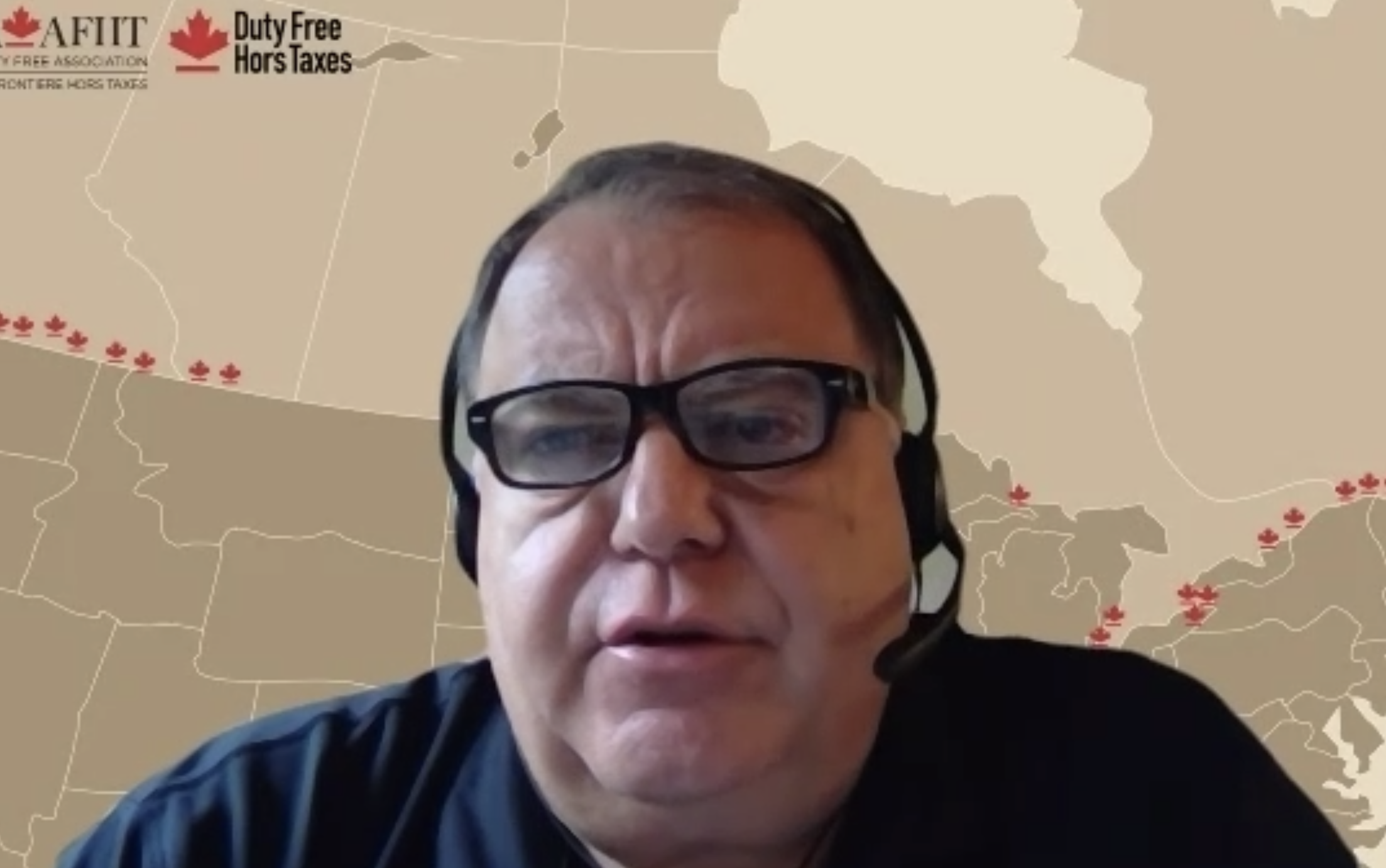
At an online press conference on Wednesday, FDFA Executive Director Barbara Barrett and Board Member Philippe Bachand addressed the challenges facing the industry, with most stores shuttered and sales (currently mainly from commercial traffic) down -95% across the board on 2019, with the US-Canada border closed for non-essential travel. Barrett said: “We have taken on significant debt just to survive this long but we still have no end in sight. Through no fault of our own but due to the border closure our businesses are in critical condition.”

She said that the land border sector – mostly small, independently-owned local retail businesses – was seeking “fairness” from government.
The first element required is access to relief funding to help businesses survive, she said. “Duty free stores employ thousands of Canadians and keep billions of dollars in revenue in Canada instead of being lost to the US duty free stores just down the road. Budget 2021 announced a C$500 million Tourism Relief Fund and we are asking for a small but fair part of this relief. We want a C$200,000 (US$160,000) per store grant programme for C$6.6 million (US$5.3 million) overall, based on size and need.
“We are also asking for export designation. Despite being for export only, land border duty free products are subject to domestic policy [such as Canadian labelling on products that can only be exported Ed]. This puts the stores at a competitive disadvantage with US duty free retailers and ultimately results in significant revenue loss. It is critical to the recovery and the competitiveness of our vibrant Canadian duty free industry that it be treated as export only and given export designation. Having a release from these policies would allow us to get on our feet faster and recover faster.”

Restrictions on discretionary travel between the US and Canada are due to expire on 21 July but observers say this will likely be replaced by a phased reopening plan, with some restrictions on non-essential travel continuing.
Outlining the situation faced by the 33 land border stores in Canada, Barrett noted that these shops are “an integral part of our border town communities and the tourism industry in Canada, acting as ambassadors to visitors to our country.
“We are an export-only business highly regulated by the Canadian Border Services Agency (CBSA). Every item and every human that enters our store must exit into the US. This means that for 16 months, we have been 95% to 100% shut down. What business can be closed for 16 months and be expected to survive without additional support?
“While other businesses have been able to open at times and have been able to pivot to other business models such as online sales, or curbside pick-up or delivery or takeaway, our highly regulated business model does not allow us to do so. We are not like airport duty free stores that are owned and operated by non-Canadian large companies who have been able to serve those flying over the border, while we remain shut out as Canadians are unable to drive across the border.
“What’s more, we have hundreds of thousands of dollars of inventory that will have to be destroyed or thrown into a dumpster as it reaches its expiration and no way to return it or sell it. We cannot even donate it without significant cost.”
The FDFA said that certain government relief programmes [notably wage and rent subsidy programmes -Ed] have been critical to survival to this point, but these are set to wind down from this week, even before travel recovery begins.
Bachand said: “We closed our store, Philipsburg Duty Free, in March 2020, and reopened in June to serve limited numbers. We had salary subvention but this now goes to 60%, 40%, 20% and eventually to nothing but we still need to keep our store open as we have hundreds of thousands of dollars of stock. We are only serving some truck shoppers and doing 2% of normal business but we need to survive, pay our staff and have overheads – and none of this will be subsidised.”
Barrett said: “We are keenly aware that if our business as one of the most devastated sectors falls victim to the timing of [support] withdrawal, we will, along with the entire tourism industry, be decimated and might never fully recover. This means that small communities, in particular border communities, will no longer be able to support tourism and will ultimately crumble.
“As long as the government keeps the border closed, we cannot do our business and we are asking to be able to survive to have a future. Retailers and their employees did not make business mistakes or plan badly. We closed to protect Canadians and we deserve not to be left behind and to have a 40-year-old export sector killed. We were happy to do our part to keep Canadians safe. And we are now asking for the government to do its part to help us survive and have a viable future. This to us seems like a matter of fairness.”