


New research from global management consultancy Kearney reveals that the downturn in “revenge buying” and the slow pandemic recovery led to a decline in travel retail spending.
The new data shows a year-on-year drop of -29% in average travel retail spend per passenger, with only 5-10% of travellers spending on impulse purchases at airports, while 64% are dissatisfied with travel retailer pricing or the assortment.
These factors have prompted a disconnect between price-centric models and new customer expectations, the study suggests.
The findings appear in Kearney’s new report conducted for the Tax Free World Association, Travel Retail Faces Its Moment of Truth: Strategies to Reinvigorate the Marketplace. The research was developed from industry data and a survey of 3,500 customers across ten countries.
The end of ‘revenge buying’
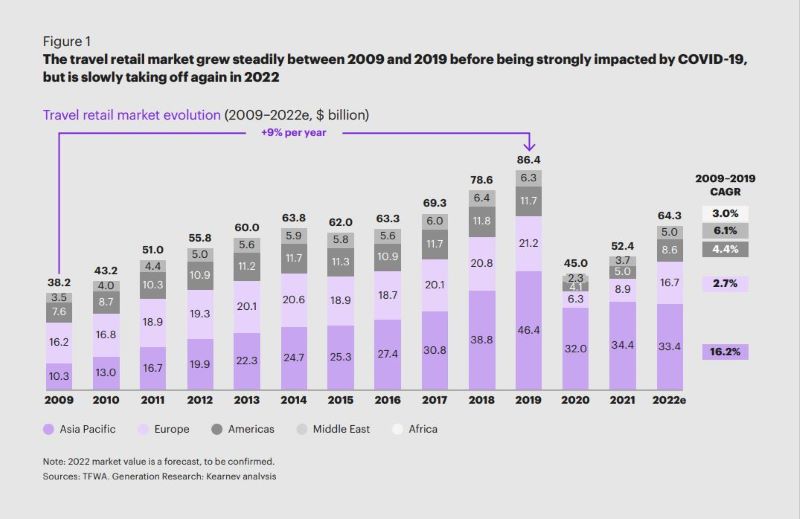
Despite the strong growth in travel retail in 2022, where according to Kearney passenger volumes reached 75% of 2019 levels, the study shows that full global traffic recovery will likely be achieved by 2024.

Despite the continued growth momentum in travel, average spend per traveller still slid by -29% to just US$17 in 2022. The decline was due to a slowdown in what is dubbed ‘revenge buying’ or the post-pandemic shopping spree.
The data reveals that the disconnect between consumer expectations and the current travel retail model is also a significant factor.
Shift in travellers’ expectations

While competitive pricing has been integral to the travel retail industry’s value proposition, the new survey finds that more than 50% of travellers perceive that duty prices are not as competitive compared with domestic retail.

It also reveals that 33% of the respondents do not shop in airport outlets because product assortments don’t match their expectations, leading to a conversion rate that is much lower than in traditional shopping centres.
Only 5-10% of travellers buy in airport duty free stores, compared with 40-60% of visitors in downtown shopping centres.

New generation of consumers are changing the rules
The emergence of a new generation of travellers, Gen Z and Millennials, has also changed the travel retail landscape. These groups are seen to become a larger segment of the travelling population, predicted to be more than half by 2025.
While older travellers are more likely to choose cost over experience, 77% of Gen Z or Millennial travellers consider experience as a key reason for purchasing a duty free item.

According to Kearney’s report, global passenger numbers will reach 83% of 2019 numbers by 2024 (4.55 billion), but traffic volume will not translate into consumption growth. To ensure an increase in consumer demand, Kearney suggests a fundamental shift in the industry’s value proposition.
Creating a consumer-centric travel retail value proposition
Aside from competitive pricing, travel retailers should also have the right assortment, personalised engagement, a tailored shopping experience and top-notch services, Kearney’s study suggests.
According to the survey, 55% would be willing to buy at duty free stores if items are sold for more competitive prices, while 37% are likely to shop if there are exclusive products on offer, 17% if delivery is available, and 32% mentioned experience as a key reason to buy.

Kearney Partner and Head of the Consumer Goods, Retail and Luxury Business for Europe Charles-Etienne Bost said: “The pandemic was clearly a significant shock to the travel retail industry – and one it is still recovering from.
“However, while the pandemic was a black swan, the underlying factors that have necessitated a rewiring of global aviation and travel retail were lurking even before the first headlines from China. The important thing will be to recognise how passenger behaviours and trends around travel have changed.”

Kearney Partner and Lead of Luxury Business for Europe Vincent Barbat added: “The trinity model of airports-retailers and brands worked for years. Now, it’s time to update our thinking around travel retail.
“A pentarchy model, adding in carriers along with digital and media partners, now better describes the distinct forces that need to be present to best serve air travellers and their needs. This isn’t to suggest some rosy cliché that we all simply need to work together.
“It’s a pragmatic profit and growth-driven approach to keep the new trends that are influencing duty free consumers at the centre of business models for a new age.”
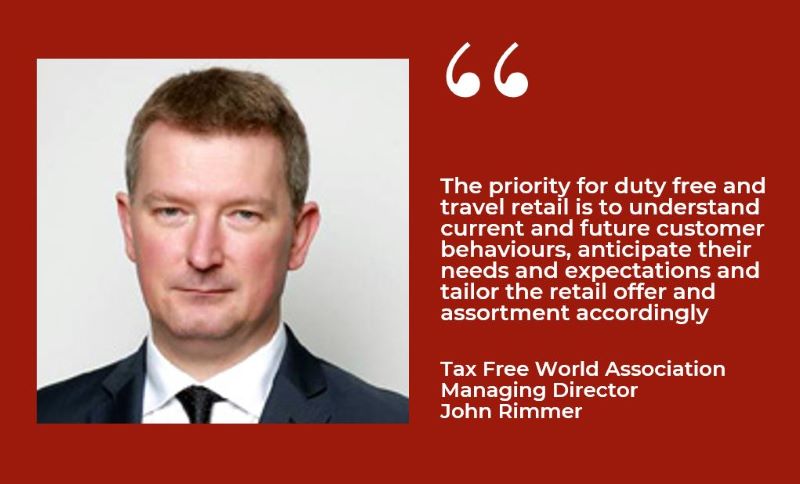
Tax Free World Association Managing Director John Rimmer concluded: “As with any retail industry, the priority for duty free and travel retail is to understand current and future customer behaviours, anticipate their needs and expectations, and tailor the retail offer and assortment accordingly.
“It is difficult to promote our industry when we are unable to accurately define the level of sales it generates, and therefore, the contribution we make to the travel industry worldwide.
“Initiatives such as this report from Kearney and the European Travel Retail Confederation Index are steps in the right direction, but it requires a coordinated global approach with the cooperation of all stakeholders.” ✈