


CHINA. China’s decision to alter its long-running dynamic zero COVID policy has triggered a surge in domestic and international flight bookings, according to the latest data from travel analyst ForwardKeys.
On 7 December, Chinese authorities announced that a negative PCR test would no longer be required for air travel between provinces. Domestic flight bookings immediately surged +56% on the previous week, accelerating to +69% the following week.
On 26 December, China removed all COVID-related restrictions on domestic air travel. Consequently, bookings surged again, reaching 50% of 2019’s level in the final week of the year.
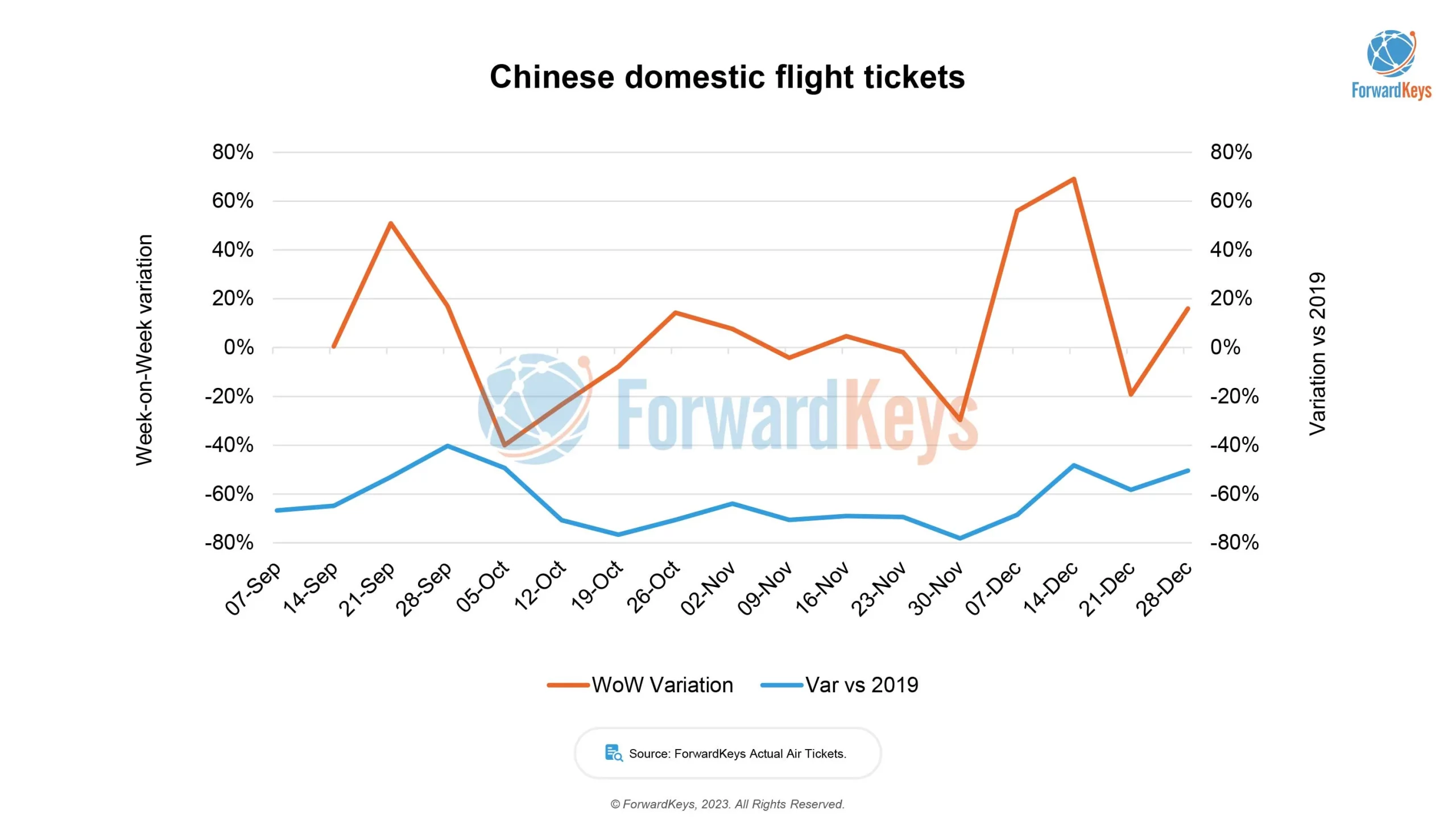
As of 3 January, domestic flight bookings during the upcoming Chinese New Year period {for these purposes noted as 7 January to 15 February -Ed}, were -71% behind pre-pandemic (2019) levels and -8% behind last year. The most popular destinations were Beijing, Shanghai, Chengdu, Kunming, Sanya, Shenzhen, Haikou, Guangzhou and Chongqing. Before the announcement on 7 December, bookings were -91% behind 2019 levels.

China’s aviation regulator plans to restore flight capacity to 88% by 31 January. However, a full recovery is not possible immediately, as the industry needs some time to rehire staff and meet all flight safety and service requirements, Forward Keys said.
Spike in international flight bookings
For Chinese outbound travel the outlook looks promising following the 8 January scrapping of inbound quarantine requirements and the effective opening up of the country’s borders. Chinese citizens can now renew expired passports and apply for new ones.
Outbound flight bookings between 26 December and 3 January jumped +192% year-on-year, positive news though still -85% behind pre-pandemic levels.
Currently, the most popular return trips are to the two Chinese Special Administrative Regions of Macau and Hong Kong, along with Tokyo, Seoul, Taipei, Singapore, Bangkok, Dubai, Abu Dhabi and Frankfurt.
Bookings to Abu Dhabi, which has traditionally been a major gateway between China and the west, are -51% behind 2019. Looking at onward bookings from there, 11% will go to Paris, 9% to Barcelona, 5% to London, 3% to Munich and 3% to Manchester.
Of bookings made between 26 December and 3 January, 67% were for travel during the Chinese New Year period.
ForwardKeys VP Insights Olivier Ponti commented: “Although Chinese New Year is likely to see international travel rebound for the first time in three years, we will need to wait longer before we see a resurgence in Chinese tourists exploring the globe.
“The reasons are: First, current scheduled international flight capacity is only at 10% of 2019’s level; and owing to approval requirements for traffic rights and airport slots, it will be difficult for airlines to gear back up in less than a few months.
“Second, ticket prices remain high, with average air fares in December +160% higher than in 2019. That said, there has been a downward trend since June, when quarantine was reduced from three weeks to seven days, and then to five days in November.”

“Third, some destinations, including the US, the UK, India, Qatar, Canada, Australia and all 27 EU member countries now require a pre-flight COVID-19 test for Chinese visitors; and others, such as Japan, South Korea and Italy, impose testing on arrival and quarantine for those who test positive.
“Finally, a bottleneck processing passport renewals and visa applications is likely; and some countries, such as South Korea and Japan, are restricting short-term visas for Chinese travellers until the end of this month.
“Right now, we expect the Chinese outbound market will pick up strongly in Q2 2023, when airlines schedule capacity for the spring and summer, which include the May holiday, Dragon Boat festival in June and summer holidays.”