


GERMANY. “Transformation does not happen by waiting. It happens when we actively shape what comes next.”
So says Gebr. Heinemann Commercial Effectiveness Manager Oliver Kreft as the travel retailer and distributor seeks to create more curated, relevant assortments and clearer value propositions using data in new, dynamic ways.
Kreft spoke to industry media at the company’s annual press conference in May, as Heinemann continues to implement the results of a major global Assortment Steering and Efficiency project.

This features clearer processes and digital tools such as an ‘assortment engine’ for continuous optimisation. To date it has also played a part in resizing assortments across categories, removing some SKUs while introducing others that are more audience-relevant for particular stores.
He sets this sets against the wider Heinemann picture – the company manages 215,000 SKUs across its stores, and 30% of these are loss-making end to end, while 50% are cannibalising sales rather than adding value.
Kreft says, “The question is not whether travel retail has a future. The question is, how do we unlock its next level?”
“We need to become sharper, more forceful and ultimately more relevant,” he adds. “And we have more opportunity. Customers are more informed, more selective and more engaged than ever. And the greatest thing is technology gives us transparency and analytical power we never had before.”

Data-driven decision making sits at the core of this new transformation. Critical too is differentiation to ensure travel retail is not uniform but rather “local, personal and contextual”. Putting this into practice demands expertise and accountability across the entire Heinemann group, plus a relentless focus on the customer, says Kreft.
What has become clear, he notes, is that average spend growth cannot be driven only by isolated actions.
“More products do not generate more turnover. Price alone does not win. Promotion alone does not win. What wins is orchestration, curated instead of overloaded, targeted instead of blanketed, meaningful instead of noisy.
“Commercial excellence becomes a true differentiator only when the whole system is managed end to end.”
On moving from data to decisions, Kreft says that the biggest impact comes from bringing insights and data to the people who make decisions on day-to-day operations, with clear and shop-specific recommendations.
Rather than seeking quick wins, Heinemann is seeking to reshape processes, routines and behaviours at scale across the group to make better decisions using data.
An example is the reinvention of the company’s assortment management, noted above.
For the first time, Heinemann is pulling together all sources of relevant data to make analytical decisions and create the full picture by article or category.
Using mathematical and analytical methods the company identifies the sweet spot of how many SKUs are needed in a particular category to satisfy the needs of customer groups in any given store.
A further requirement is to think like customers, says Kreft. “In wine, for example, is price level or country of origin or the grape more important? Everyone will judge this differently but we have analytical methods that help us measure what our customers choosing and which are the most important attributes.”
Also vital, he adds, is to “give data a strategy. Even if data leads, “then strategy must guide”. This means overlaying the data with knowledge of what can make the assortment inspirational or different, even if it is in some cases loss making.
Kreft says, “That is why we enrich our methodologies with guardrails that reflect boundaries and strategies that define our assortment besides analytical approaches. And that is the true game changer, the determination of relevance.”
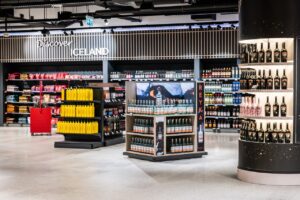
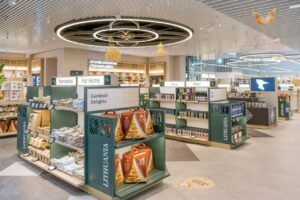
Housing all key data in an assortment engine provides recommendations for each individual shop. This makes decision making more advanced, faster and more dynamic, and it is now rolling out to all locations across the group, beginning with Vienna, Frankfurt and then Istanbul airports.
The future as the system evolves will be to finetune assortment, price and promotion to ensure the optimal approach in each shop, and in time this can become even more dynamic by taking seasonality or flight schedules into consideration.
Crucially, relevant resizing of the offer is not just about delisting under-performing items, he insists. “The data might recommend that we reduce our skincare offer somewhere by -20%, but that does not take into account another 10% that may be recommended to be added to this location via our global database,” says Kreft.
The other central element in this transformation is collaboration.
“If we identify an analytical best option, this might have impact on suppliers, on brands and on airports and there are requirements from different stakeholders,” notes Kreft.
“Using real analytical power and data means also to overcome routines and beliefs to find the best option for our customers. It really is a mind shift. Each transformation is 70% mind shift and only 30% might be technology and data.
“Partnership, and that is very crucial for us, is where transformation happens in the end. We are human-centric and that remains a very important part of our business.”
He concludes, “In the end it is about customer relevance. We need to have the best curated assortment that we can offer our customers.” ✈