

MIDDLE EAST. The joint US-Israel strike on Iran on 28 February and subsequent regional escalation have combined to devastating impact on the travel, tourism and travel retail sectors.
Middle East airports, retailers and food & beverage operators face heavy daily losses while the crisis continues. Airport stakeholders abroad also continue to count the cost of suspended flights to, through and from the Middle East.
The Moodie Davitt Report is keeping readers updated on a crisis with major repercussions for our industry.
{Note: The Moodie Davitt Report’s role is to report on the business implications of the war, not to take any partisan position. However, we will report on both opposition to and support for the conflict to place the implications for our sector in rightful context.}
Read our earlier extensive coverage of the Middle East crisis via this link.
13 May
MIDDLE EAST/INTERNATIONAL. A new assessment of the Gulf conflict’s impact on the aviation sector from Airports Council International (ACI) Asia-Pacific & Middle East and Flare Aviation Consulting has revealed that nine major Middle Eastern hub airports operated at an average of just 53% of scheduled capacity across March and April.
According to the data shared by ACI, by the same measure, activity collapsed to only 32% on the first day of the conflict before recovering gradually to around 63% by late April.
The airports studied collectively served 324 million passengers in 2025, accounting for roughly 70% of all Middle East traffic. Their strategic importance extends far beyond the region, serving as essential connectors between Asia Pacific, Europe, Africa and the Americas, ACI noted.
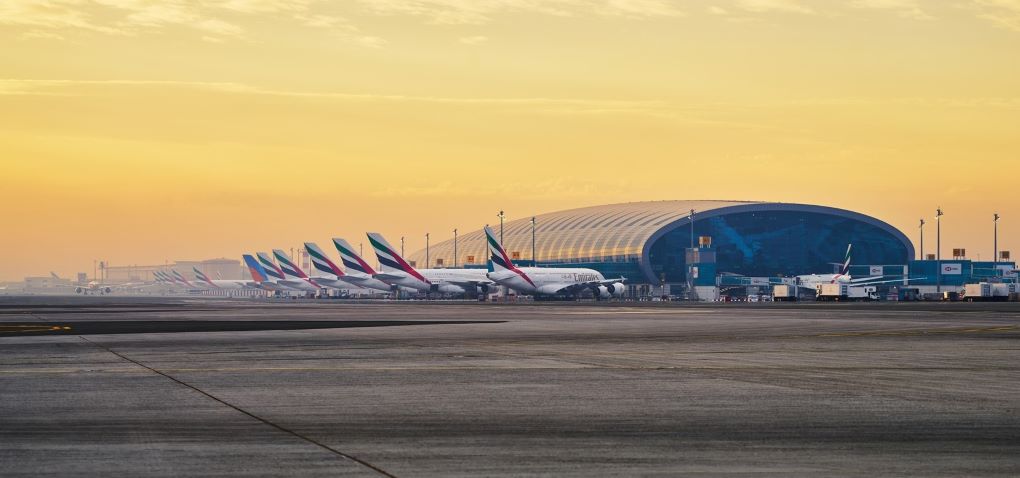
The scale of disruption has been severe. An estimated 27 million passengers were unable to travel as planned during the two-month period, representing a -54% year-on-year decline, the data shows. Cargo flows suffered similarly dramatic damage, with freight volumes plunging by 620,000 tonnes, down -52% compared with the same period last year.
The financial consequences are equally stark. The nine airports are estimated to have lost between US$900 million and US$1 billion in revenues across March and April alone – approximately -55% below projected levels. For airport operators carrying substantial infrastructure investment obligations and high fixed costs, the crisis represents a major structural cash-flow challenge.
The disruption has exposed the fragility of global East-West connectivity, ACI said. In 2025, around 197 million passengers travelled annually between Asia Pacific and western destinations, with approximately 18% (roughly 97,000 passengers per day) transiting through affected Gulf hubs.
Within hours of the conflict’s outbreak, nearly one-fifth of global East-West connecting capacity was effectively removed from the market.
The ACI data shows that airfares were affected immediately. Direct long-haul fares between Asia and western markets surged in March to 185% of 2025 benchmark levels, more than double the traditional premium over indirect Gulf routings.
Even projections for July and August show fares remaining around 50% above pre-conflict levels as airlines grapple with longer routings and constrained capacity.
Importantly for the airport sector, ACI stressed that regulated airport charges have remained unchanged and are not responsible for higher ticket prices. Instead, reduced airline competition, fuel inflation and operational disruption are driving fare escalation.
For travel retail, the implications are profound. Lower passenger throughput across the Gulf’s major connecting hubs inevitably translates into reduced footfall and weaker non-aeronautical revenues, particularly in duty-free, luxury goods and food & beverage categories heavily reliant on transfer passengers.
Yet amid the turmoil, Asia Pacific traffic overall has shown resilience, ACI observed. Most airports surveyed continued to record underlying growth outside Middle East routes, although operators warned that sharply higher jet fuel prices – now close to double pre-conflict levels – pose an increasing risk to recovery.
ACI Asia-Pacific & Middle East Director General Stefano Baronci warned that the coming summer period will prove critical. Recovery, he said, is expected to follow a prolonged “swoosh-shaped” trajectory rather than a rapid rebound, with recovery dependent on airspace reopening, fuel market stabilisation and restoration of passenger confidence.
6 May
UAE. More positive news reaches us from the UAE, as Avolta’s HMSHost Middle East reports further progression in its reopening programme at Dubai International Airport (DXB).
All’Antico Vinaio (Terminal 3), Jones the Grocer (Terminal 1- Arrivals) and Taste of India (Terminal 1- Departures) have recommenced trading, completing the return of all HMSHost Middle East DXB units.

A note from the company said: “This marks an important step forward for our teams and partners, and we look forward to serving our guests once again across all locations with renewed energy and commitment.”
4 May
UAE. Dubai Airports has issued an upbeat note about passenger traffic for the rest of 2026 with airspace within the UAE now fully open.
The airport company said it is “moving decisively to scale up operations, increasing flight movements in line with available regional routing capacity”.
This is despite the continuing impact of war in the region, which saw DXB passenger traffic fall -20.6% year-on-year in March (to 18.6 million), with March travel numbers down by -65.7% year on year to 2.5 million.
Following the lifting of all precautionary restrictions on UAE airspace, Dubai Airports has “entered the next phase of recovery operations”, ramping up daily fight movements and enabling airlines to restore schedules. A statement said, “Capacity is now primarily aligned to the availability of regional flight paths outside of the UAE, with coordination to optimise flows across neighbouring airspace.”
Click here for the full story.
3 May
INTERNATIONAL. American Express Global Business Travel (Amex GBT) has highlighted the profound disruption caused by the Middle East conflict on corporate travel patterns. Amex GBT’s April 2026 Business Travel Bulletin underscores a sharp shift from routine operations to crisis management across the region.
The report notes the outbreak of war on 28 February triggered an immediate surge in cancellations, itinerary changes and traveller support requests, as companies moved quickly to reassess travel risk and ensure employee safety.
Airspace closures and security concerns have significantly curtailed travel to key parts of the Middle East, while also creating knock-on disruption to global routes due to rerouting and capacity constraints, according to the research.
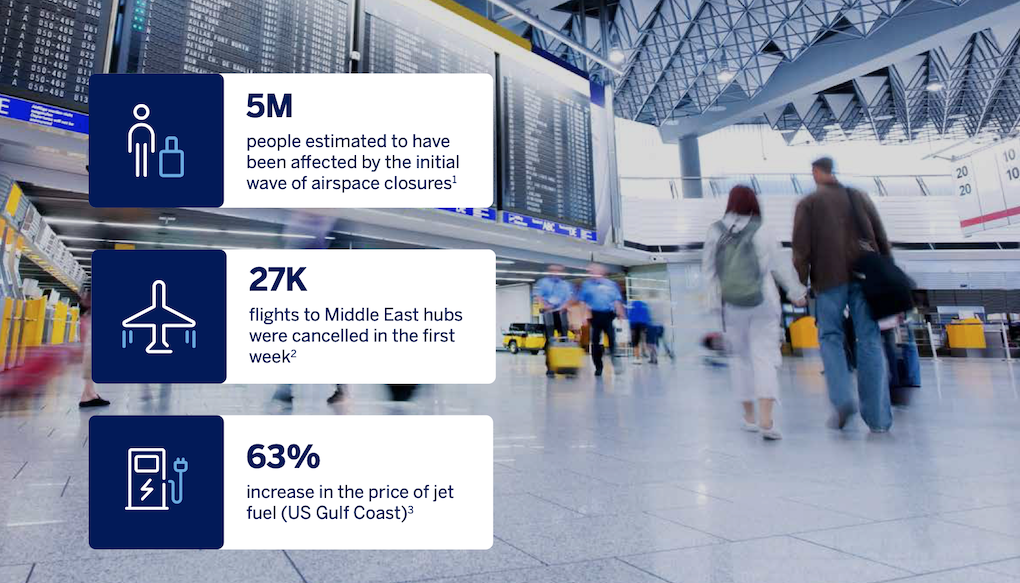
Amex GBT emphasises that business travel to and within the region has become highly fluid, with companies increasingly adopting flexible booking policies and enhanced duty-of-care measures.
The situation has reinforced the critical importance of real-time information, traveller tracking and rapid response capabilities, as organisations navigate an environment defined by uncertainty and rapidly changing conditions.
At the same time, the bulletin points to wider implications for global business travel, including potential increases in journey times and costs linked to airspace restrictions, as well as indirect impacts on supply chains and corporate mobility strategies.
Despite this, the report also notes that underlying demand for business travel remains resilient outside the immediate conflict zone.
The report concludes that while the short-term outlook remains volatile, companies should prioritise preparedness, flexibility and clear communication, positioning themselves to respond quickly as the geopolitical situation evolves and recovery eventually takes shape.

Download the full report by clicking the image above.
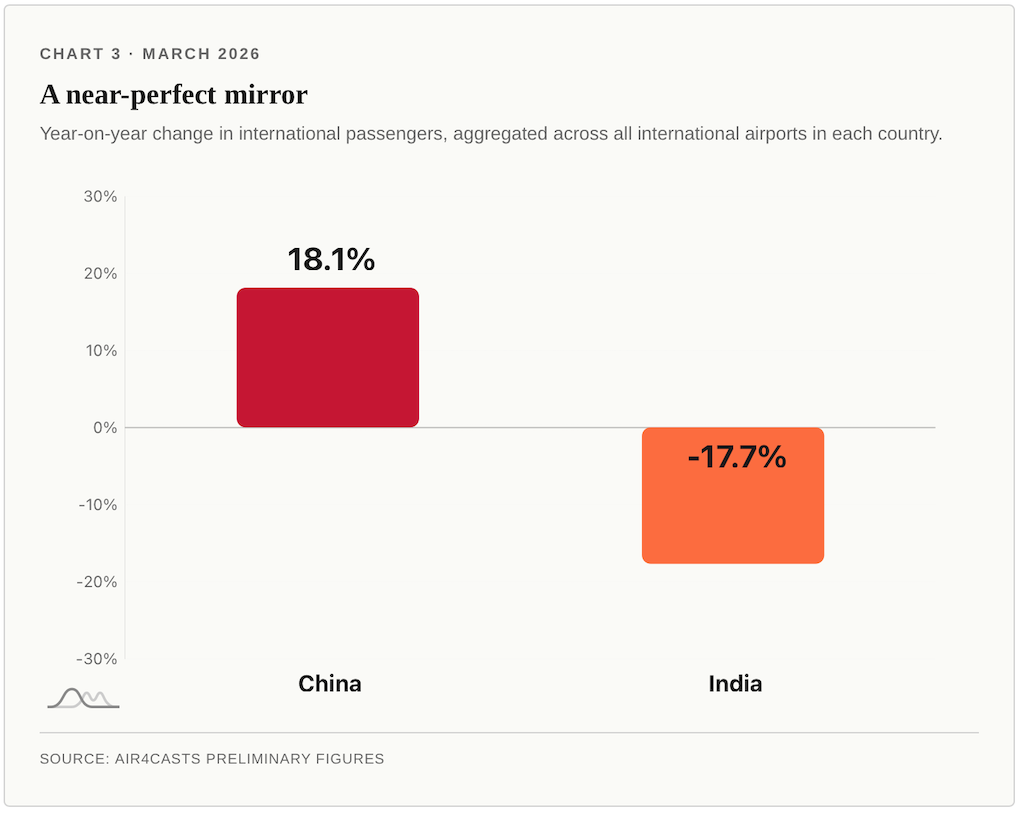
CHINA/INDIA. UK aviation and travel retail forecasting, analysis and research service Air4Casts has painted a stark contrast between China’s and India’s international airports in the first full month following the US and Israel attack on Iran.
“The trigger was immediate,” the company writes in an introduction to its excellent latest Air4casts Travel Retail Brief*. “US and Israeli airstrikes on Iran on 28 February forced Gulf airspace closures and wiped out more than 21,000 flights across seven major hubs in just four days.
“But the real story lies in the aftermath. A month on, the preliminary March traffic data tells a sharper, more uneven story. The countries with the deepest exposure to the Gulf travel corridor are the ones now showing the biggest declines – and almost no-one is more exposed than India.
“The contrast with mainland China could hardly be starker. While India’s top international gateways posted year-on-year passenger declines ranging from a slight dip to almost a quarter, China’s big five hubs all grew, several of them at double-digit rates.”
Click here for our extensive standalone report.
2 May
USA. The collapse of Spirit Airlines, the American ultra low-cost carrier headquartered in Dania Beach, Florida, has underscored the widening financial fallout from the Middle East crisis, with surging fuel costs emerging as a major factor in the carrier’s abrupt shutdown.
Announcing an immediate wind-down of operations on 2 May, the airline confirmed that all flights have been cancelled following unsuccessful efforts to restructure its business and secure additional funding.

While the company did not explicitly reference the regional conflict, it pointed to a “sudden and sustained rise in fuel prices in recent weeks” as a critical blow to its financial viability.
Chief Executive Dave Davis said the spike in fuel costs left the airline with “no alternative” but to cease operations, noting that sustaining the business would have required hundreds of millions of dollars in additional liquidity that was ultimately unattainable.
1 May
CHINA. The Iran war is having a profound and immediate impact on Chinese outbound travel sentiment towards the Middle East and North Africa, according to new research from Dragon Trail International.
The research highlights another layer of pressure on a region already grappling with major aviation disruption.
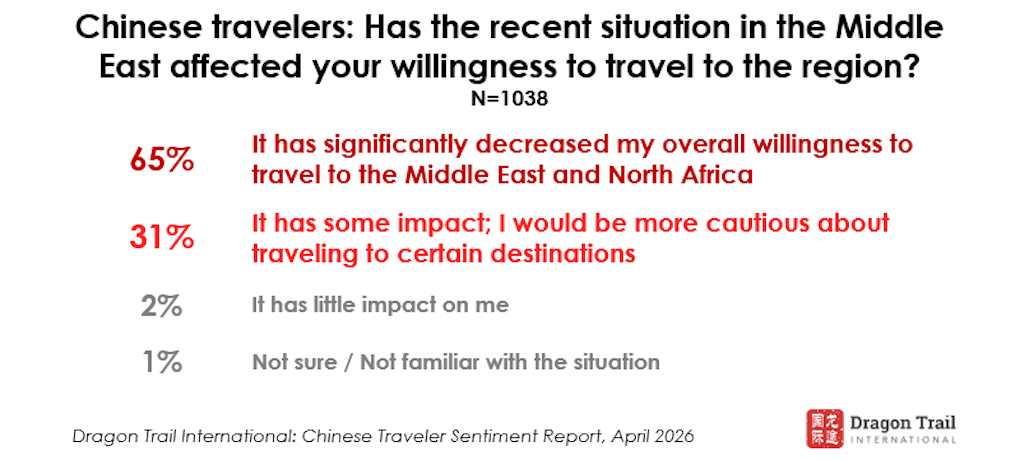
Survey data from the Chinese Traveler Sentiment Report collected in spring 2026 shows that 96% of Chinese respondents reported a negative impact on their willingness to travel to MENA, with 65% saying the conflict had significantly reduced their interest.
According to the report, the region has consequently fallen from seventh to tenth place in global travel preferences, reflecting a sharp deterioration in perception driven by safety concerns, airspace closures and ongoing instability linked to the war.
Confidence has been particularly affected in Gulf markets such as the United Arab Emirates and Saudi Arabia, where safety ratings have dropped markedly.
However, perceptions are more nuanced elsewhere, with destinations such as Egypt proving more resilient as Chinese travellers differentiate between conflict zones and geographically distant markets.
The impact appears most acute in the short term, the report suggests. While 57% of respondents would avoid travel to the region within the next three months, this falls to just 19% over a one- to three-year horizon, indicating that demand could recover once conditions stabilise.
Dragon Trail emphasises that rebuilding traveller confidence will hinge on improved safety conditions, alongside enhanced communication and support tailored to Chinese visitors.
In the interim, the firm advises regional travel brands to maintain long-term engagement with the market, invest in “China-ready” services and digital infrastructure, and prepare targeted offerings for early-return segments such as luxury and business travellers.
Read more from the report here.
30 April
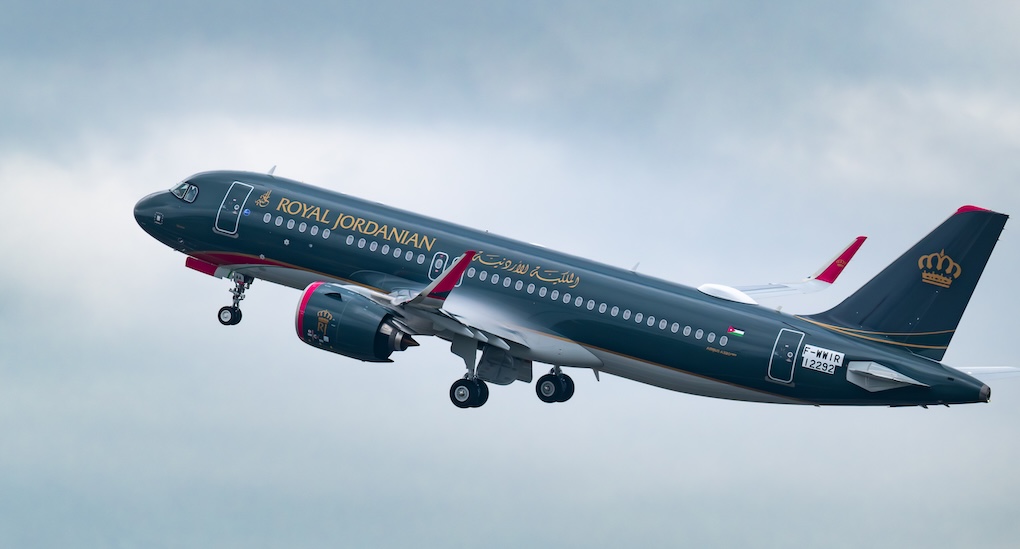
JORDAN. Royal Jordanian Airlines has reported a resilient revenue performance for the first quarter of 2026, underscoring the complex operating landscape shaped by the escalating Middle East crisis following the outbreak of conflict on 28 February.
The Amman-based carrier transported 992,000 passengers in the period, marking a +5% year-on-year increase, while revenues rose +15% to JOD195.5 million.
However, these gains were overshadowed by a sharp rise in operating costs – up 12% to JOD176.5 million (US$249 million) – driven largely by soaring fuel prices, heightened insurance premiums and extended flight routings imposed by regional instability.
The airline posted a net loss of JOD13.6 million (US$19.2 million), more than double the deficit recorded a year earlier.
Vice Chairman and CEO Samer Majali highlighted the severe impact of the ongoing conflict environment, with airspace closures and security risks across parts of the Levant and neighbouring regions forcing aircraft to avoid key corridors.
This has led to longer flight times, increased fuel burn and operational disruption across the network.
Looking ahead, Royal Jordanian Airlines said the second quarter is expected to bring intensified pressure as geopolitical uncertainty continues to suppress travel demand across the Middle East.
The carrier said it is preparing for potential flight cancellations and consolidations while striving to maintain essential connectivity to and from Jordan during a period of sustained regional volatility.
29 April
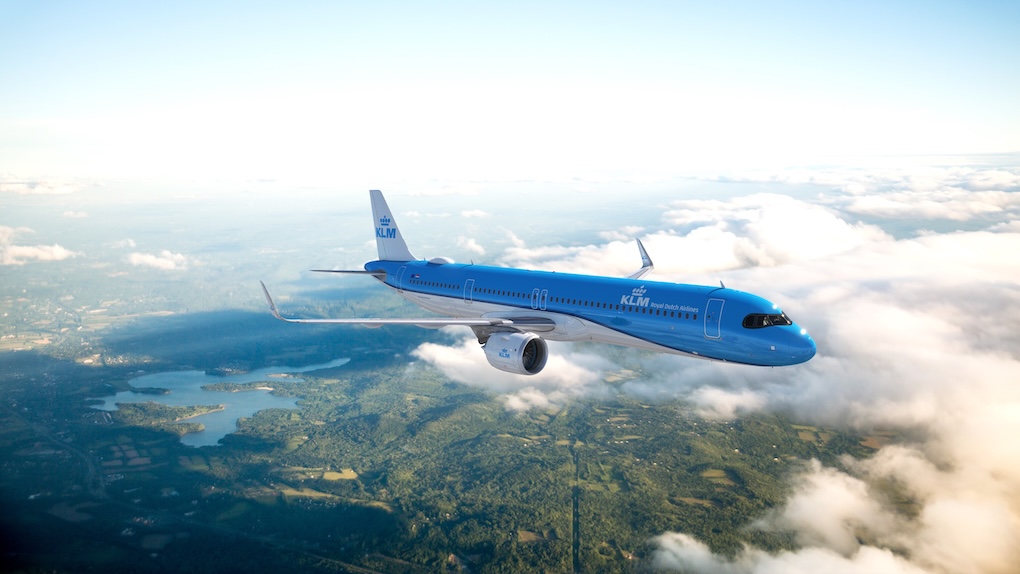
THE NETHERLANDS. KLM Royal Dutch Airlines has extended its suspension of key Middle East services, underlining the prolonged impact of regional instability on European airline operations.
In its latest update on 29 April, the carrier confirmed that flights to Dubai will remain cancelled through to 22 June, while services to Riyadh and Dammam continue to be suspended until at least 14 June.
The decision follows an earlier announcement on 21 April, in which KLM cited ongoing uncertainty linked to the evolving security situation across the Middle East, despite shifting media narratives around the crisis.
The airline said the extensions are designed to provide greater clarity for passengers amid an unpredictable operating environment, where airspace restrictions, safety considerations and fluctuating demand continue to disrupt scheduling.
INTERNATIONAL. The International Air Transport Association (IATA) has reported continued, albeit constrained, growth in global air travel demand for March 2026, as the Middle East crisis exerts a significant drag on international aviation markets.
Total demand, measured in revenue passenger kilometres (RPK), rose +2.1% year-on-year, while capacity fell -1.7%, pushing load factors up to 83.6%.
However, the headline figures mask a sharp divergence between regions. International demand declined by -0.6%, driven primarily by a dramatic -60.8% fall in traffic among Middle Eastern carriers, reflecting widespread airspace disruption, rerouting and reduced operations linked to the ongoing regional conflict.
By contrast, domestic markets remained robust, with demand rising +6.5%.
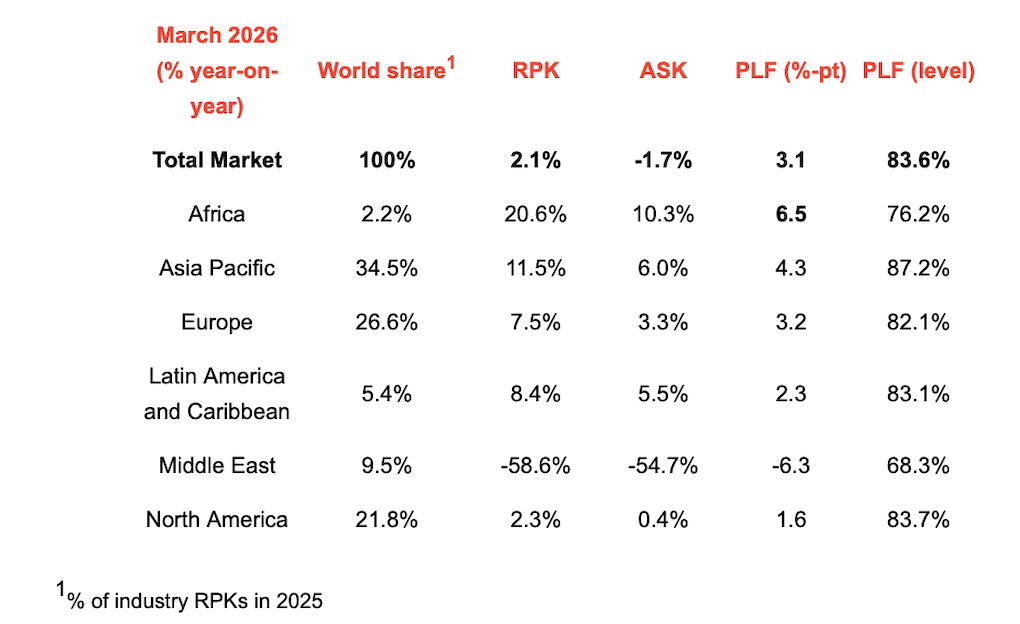
IATA Director General Willie Walsh said: “Demand for air travel continued to grow in March despite disruptions in the Middle East. The nearly -61% decline in international traffic by carriers in the Middle East did, however, restrain global growth to +2.1%. Outside of the Middle East demand grew by +8%.”
He continued: “Everybody’s watching what’s happening with jet fuel – both supply and pricing. On the supply side, over the next months we could see shortages in parts of the world with high dependence on supplies from the Gulf, especially Asia and Europe. And the extraordinarily high cost of jet fuel is increasingly being reflected in ticket prices.
“While this has not impacted March traffic or forward bookings to date, it remains to be seen at what point high prices could start to shift passenger behaviour. So far, the summer is shaping up to be a normally busy time for travel. That’s positive news, but airline resilience is being tested and stabilising the supply and price of fuel is crucial.”
27 April
QATAR. Qatar Airways is steadily rebuilding its global network as the aviation sector adapts to ongoing disruption stemming from the Middle East crisis, announcing the resumption of daily services to Bahrain and Kozhikode from 1 May 2026.
The move follows the earlier reinstatement of flights to Dubai and Sharjah in April, alongside the planned return of services to Damascus.
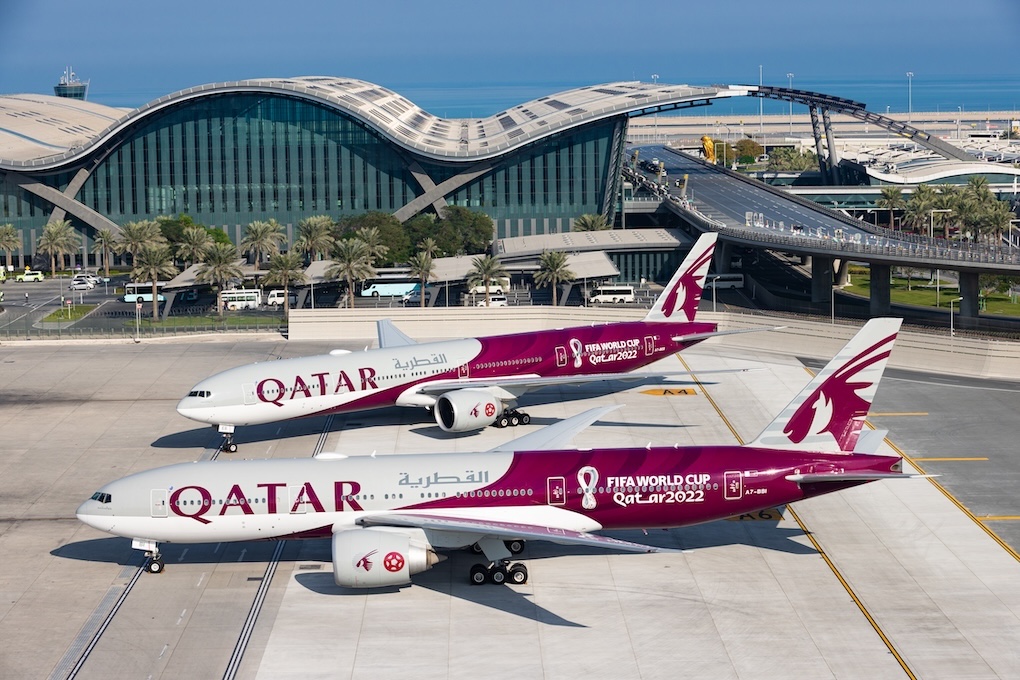
The Doha-based carrier is positioning these resumptions as part of a broader phased approach to reconnect key markets across six continents, after months of operational instability linked to the conflict that erupted in late February.
While capacity is gradually returning, the airline continues to emphasise flexibility for passengers navigating an unpredictable travel environment.
Customers holding tickets issued before 30 April for travel through mid-September are eligible for complimentary rebooking or refunds, with additional protections in place for those directly impacted by schedule changes.
21 April
QATAR. Qatar Civil Aviation Authority (QCAA) has issued a Notice to Airmen (NOTAM) announcing the gradual resumption of operations for foreign airlines in the State of Qatar via Hamad International Airport.
The Authority stated the decision “follows a comprehensive assessment of the situation, conducted in coordination with all relevant national entities, to ensure the highest levels of readiness and operational efficiency”.
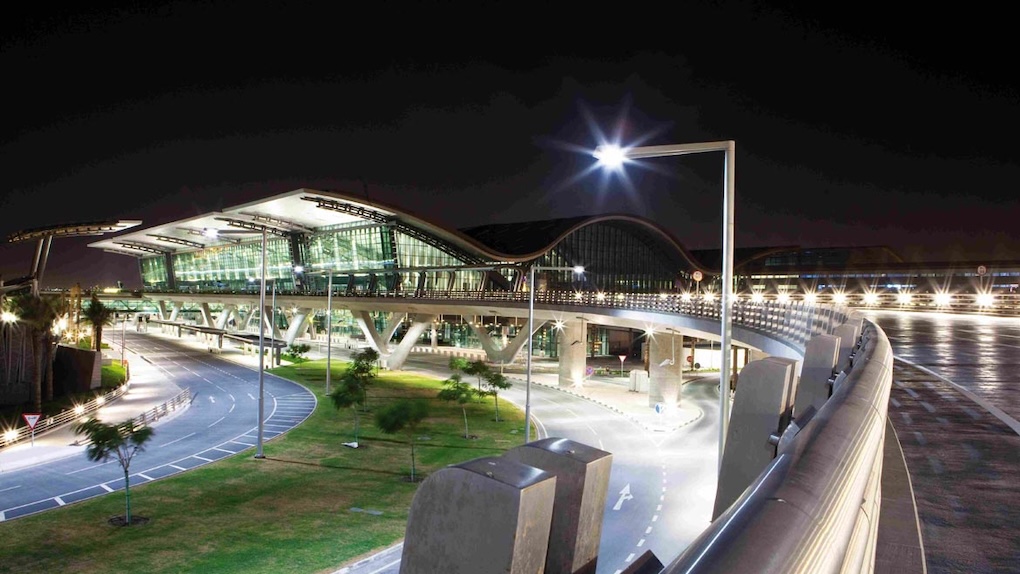
It affirmed that all flights and related operations will be carried out in accordance with the highest internationally recognised safety and security standards, with all necessary measures and precautions in place to safeguard passengers and aviation personnel.
The QCAA emphasised that safety and security remains its top priority.
We will continue to report on the impact of the Middle East crisis on travel, tourism and travel retail in coming days. ✈